Choosing your inguinal hernia repair
If surgery worries you, most repairs are minimally invasive, through a few small cuts
Dr Daniel Lee, FRCS (Edinburgh), is a former Head of Colorectal Surgery at Khoo Teck Puat Hospital.
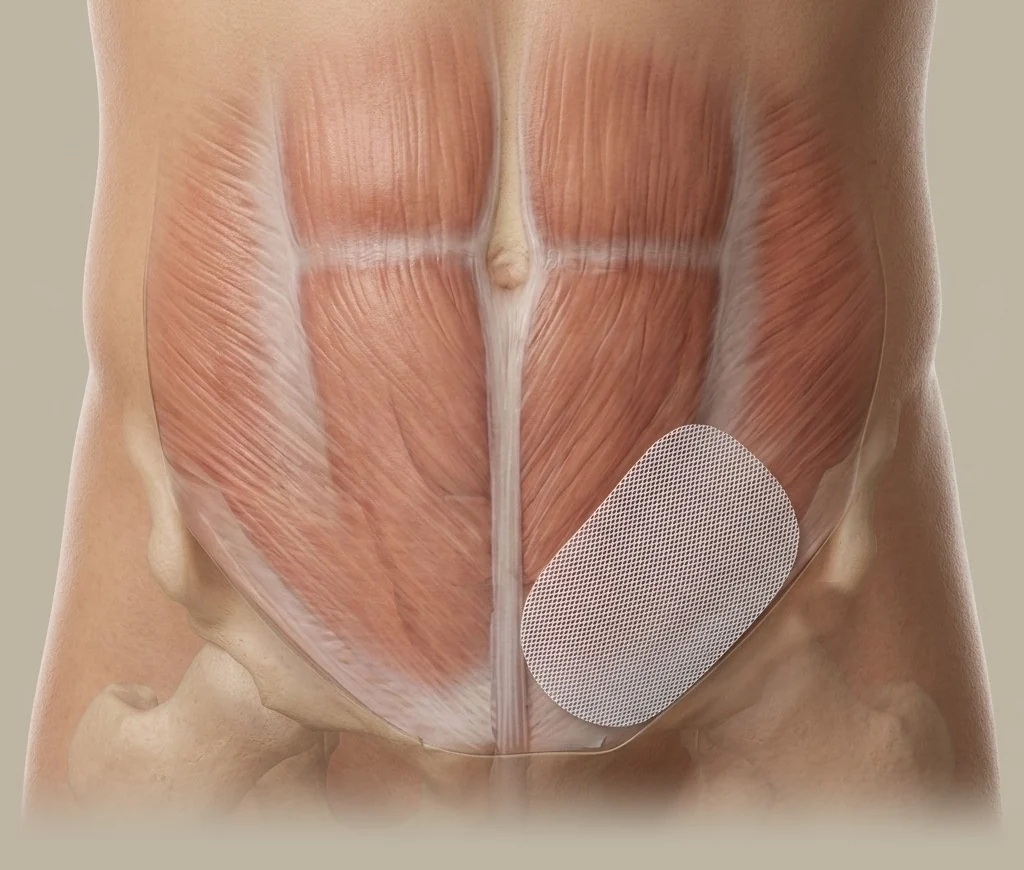
Illustration adapted from “Inguinal Hernia Repair” by BruceBlaus, CC BY-SA 4.0. Shared under the same licence.
What an inguinal hernia is, and why the groin is where it forms
An inguinal hernia happens when soft tissue, often part of the bowel, pushes through a weak spot in the muscle wall of the groin.
The weak spot is the inguinal canal, a short passage through the lower abdominal wall, just above the groin crease. In men it carries the cord to the testicle, which leaves a natural weak point and is why inguinal hernias are far more common in men.
The lump comes and goes. It shows when you stand, cough or lift, and it often slips back when you lie down.
It barely hurts at first, so many people wait for months or even years before having it checked. A hernia does not repair itself, and most grow slowly over time.
The main hernia surgery page covers how each repair works, recovery and insurance.
Inguinal hernia symptoms to look for, and the signs that cannot wait
A groin lump deserves a proper examination even when it does not hurt, because the plan depends on what the hernia is doing. These signs mean the hernia should be seen soon.

- You can see or feel a lump in the groin, with or without discomfort.
- You notice an ache, heaviness or dragging in the groin that builds through the day or after lifting.
- The lump reaches down towards the scrotum.
- The hernia is getting in the way of work, sport or daily life.
- A lump that used to push back in no longer does.
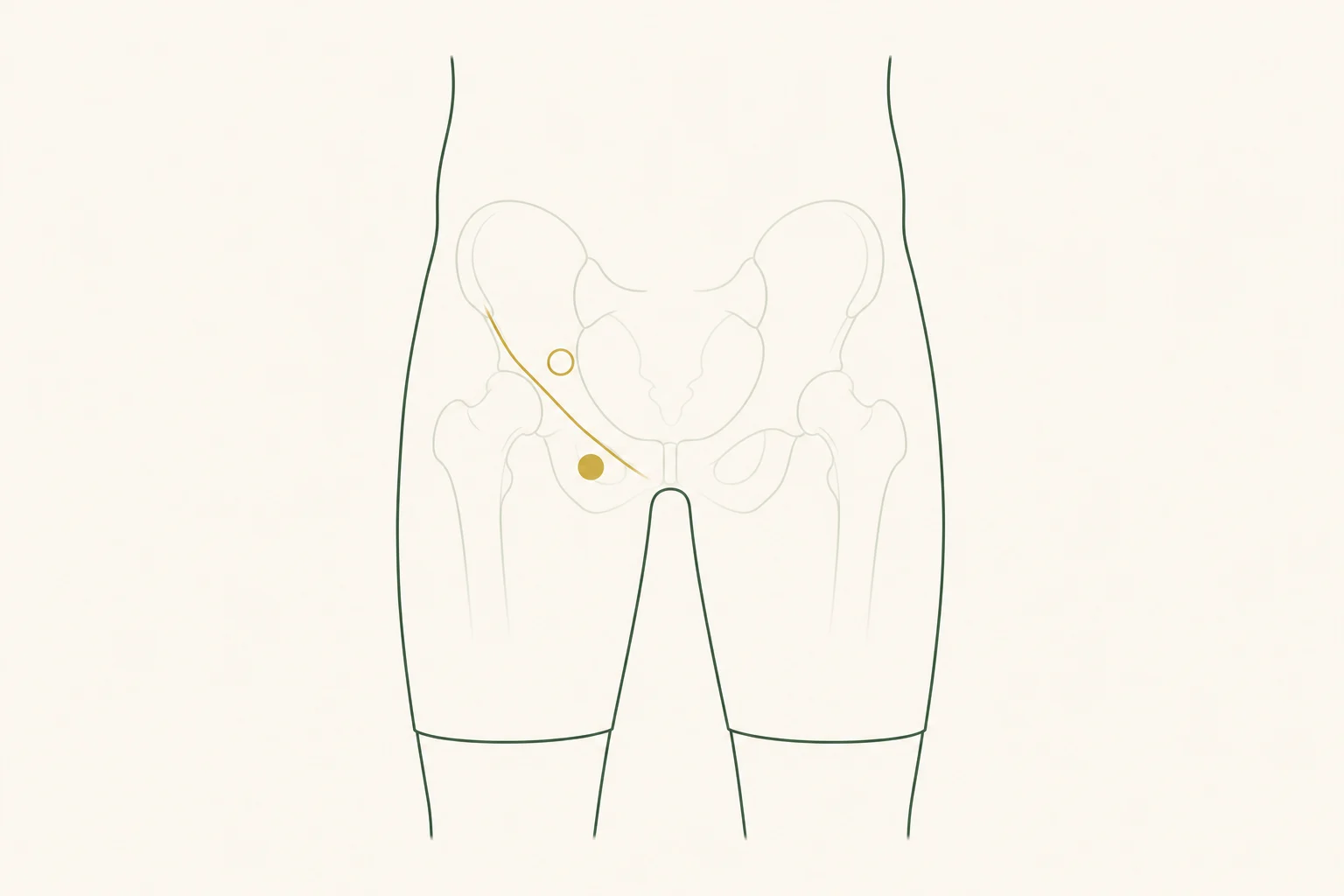
A lump low in the groin, or in the upper thigh, can also be a femoral hernia. It is more common in women and worth assessing promptly, because it can be more prone to complications. Our guide to femoral hernia explains why.
A groin lump that turns very painful and firm needs urgent care
Rarely, a hernia can become trapped and lose its blood supply, which is called strangulation. A very painful, firm lump that will not push back in, or one that comes with nausea, vomiting or red or discoloured skin, is a warning sign. If your hernia suddenly becomes very painful and firm or will not push back in, do not wait. Go straight to the nearest A&E or contact us immediately.
A bilateral inguinal hernia, on both sides, can often be repaired in one keyhole operation
Inguinal hernias can occur on one side or on both. A hernia on both sides is called a bilateral inguinal hernia.
When both sides need repair, keyhole surgery can often repair the two in the same operation.
Sometimes a hernia on the other side cannot be felt and is only found during keyhole surgery. Repairing it then can spare you a second operation, but it can add to the overall risk of the operation you are already having. The guideline update therefore advises that the decision is discussed with you before surgery, when you give your consent.
A groin hernia that reaches the scrotum is one case where open repair is often advised
In some men a groin hernia extends down towards the scrotum over time. That is a sign it should be seen soon, and Dr Lee examines you standing and lying down to confirm the hernia and how readily it pushes back in.
The international guideline update names a hernia that reaches the scrotum among the situations where open repair from the front is the better option.
Watching an inguinal hernia that barely hurts, and when repair becomes the next step
For a man whose groin hernia causes little or no discomfort, watching it for a time can be a reasonable first step in inguinal hernia treatment.
A hernia operation rarely needs to be rushed, but waiting carries a cost of its own. A planned repair is often done as day surgery, while the same hernia repaired as an emergency usually needs a hospital stay, and the bill is higher.
Dr Lee examines the hernia and explains whether watching or repair suits you, and what to look out for if you wait.
A 2021 review of nine studies followed 858 men with no or few symptoms who were watched rather than operated on at once, and watching was not linked to more complications after surgery.
2 to 3 in 100
needed an emergency operation while the hernia was watched
About 1 in 3
had an operation within 3 years, most often because the hernia began to hurt
More than 2 in 3
had an operation within 10 years
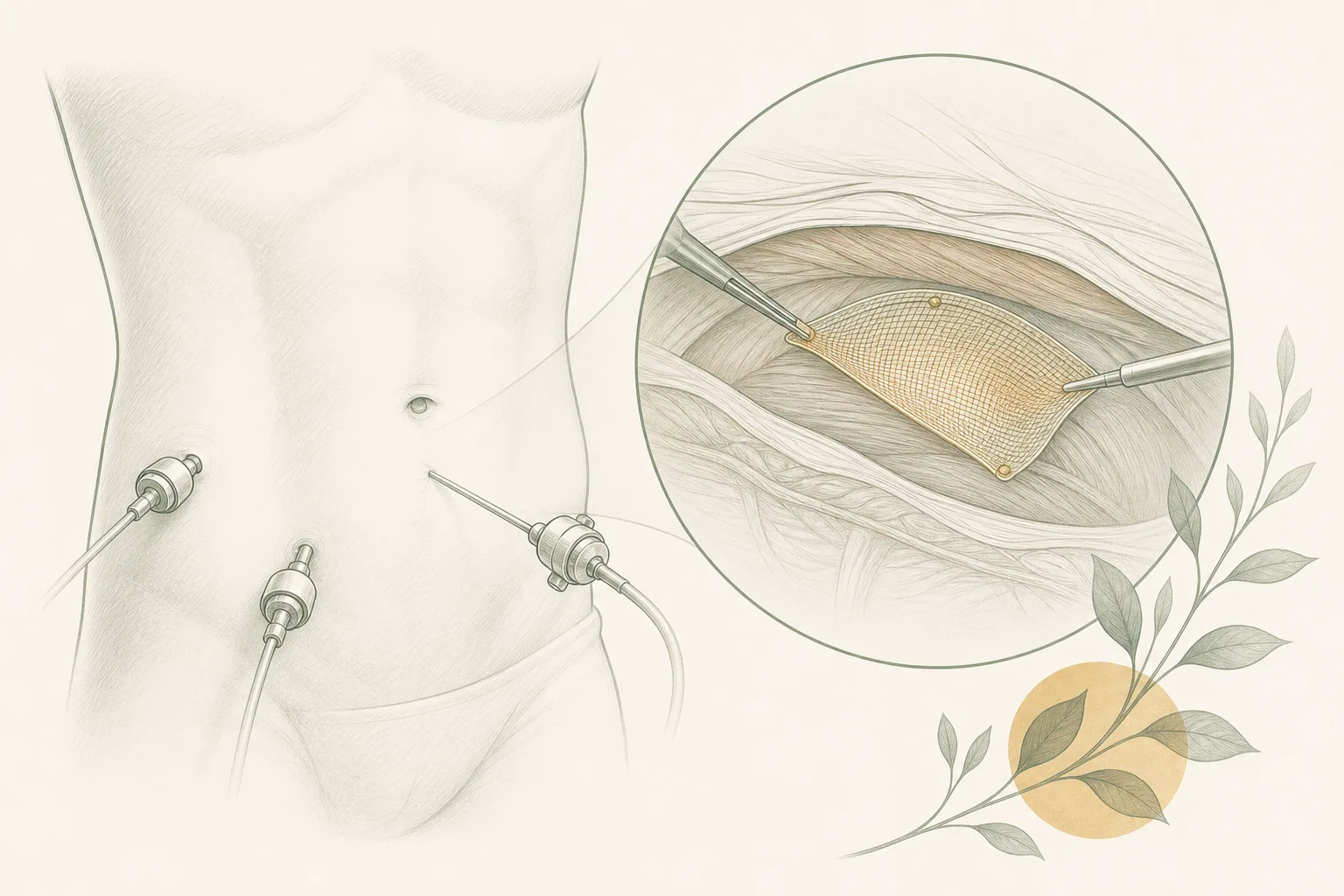
Open mesh repair or keyhole repair, and how groin hernia surgery is done
An inguinal hernia repair first eases the bowel back into place, and then a small piece of surgical mesh strengthens the weak spot.
The 2023 update of the international HerniaSurge groin hernia guidelines recommends a mesh-based repair for the majority of adults, and states that mesh reduces the risk of the hernia coming back without increasing the risk of long-lasting pain.
There are two main routes. Open repair works from the front, through one cut over the groin. Keyhole repair, also called minimally invasive repair, works from behind the weak spot through a few small cuts instead of one long one.
Dr Lee notes that most repairs today are keyhole, either laparoscopic or robotic assisted. In a laparoscopic repair, a few small cuts are made and a camera guides the surgery.
When keyhole repair is often chosen
For a simple hernia on one side, the guideline update says keyhole repair offers a quicker recovery and less long-lasting pain when the surgical team has the experience and the equipment. Keyhole repair is also often favoured for a hernia on both sides, because the two can often be repaired in one operation.
When open repair is often advised
Open repair from the front is often advised after prostate surgery, after radiotherapy to the pelvis or after earlier lower abdominal surgery, for a hernia that reaches the scrotum, and when local anaesthesia suits you better.
For an open repair of a first-time hernia that pushes back in, the guideline update recommends local anaesthesia as the first choice when the surgical team is experienced with it. It calls local anaesthesia a good alternative to general or regional anaesthesia for frail patients and for those with other health conditions. Whichever route is planned, your fitness for anaesthesia is assessed first, and the type of anaesthesia is chosen to suit you.
If a groin hernia comes back after repair
After an open repair from the front, a repeat groin hernia repair is usually done from behind, often by laparoscopic or robotic-assisted surgery, through tissue the first operation did not touch. After a keyhole repair, an open repair from the front is usually advised.
A repair matched to your hernia and your health
Dr Lee is a hernia and colorectal surgeon who performs both open and keyhole repair. He recommends one way of repairing the hernia based on your hernia, your health and your history, and explains why before anything is decided.
What the Ministry of Health fee benchmarks show for groin hernia surgery
The Ministry of Health publishes fee benchmarks for the surgeon and the anaesthetist. The two below are for a groin hernia, inguinal or femoral, and include GST.
Hernia assessment with Dr Lee: SGD 150
| Type of repair | MOH surgeon fee benchmark (with GST) | MOH anaesthetist fee benchmark (with GST) |
|---|---|---|
| Groin hernia, one sideinguinal or femoral, SF819A | SGD 3,924 to 6,540 | SGD 1,199 to 1,744 |
| Groin hernia, both sidesinguinal or femoral, SF820A | SGD 6,104 to 9,810 | SGD 1,526 to 2,289 |
These are national benchmarks before MediSave and insurance, not Dr Lee's own fee, and the hospital fee is charged separately.

Most groin hernia repairs are done as day surgery
For most patients, inguinal hernia repair is day surgery, which means you go home the same day. These are typical times after a planned repair.
Home the same day
The first few days are usually managed with simple pain relief.
Back to light duty
Most patients are back to light duty in one or two weeks, and desk work is usually earlier.
Usual activities
Heavy lifting returns last. Pain that is still there at three months should be checked.
Questions about inguinal hernia surgery, answered plainly by Dr Daniel Lee
What should I expect from the operation, and should I be worried?
Inguinal hernia surgery is one of the most common operations in the world, with more than 20 million groin hernia repairs a year.
For most patients it is day surgery, so you go home the same day. First the bowel is eased back into place, and then a small piece of surgical mesh strengthens the weak spot.
Before the operation your fitness for anaesthesia is assessed, including any heart, lung or diabetes considerations, and Dr Lee explains each step before anything is decided.
When can I walk, drive, go back to work and lift again after the operation?
Walking and light daily tasks can start straight away, and the first few days are usually managed with simple pain relief. Most people are back at a desk job and driving within one to two weeks.
Heavy lifting returns last, and by around three months most people are back to all their usual activities. Pain that is still there at three months should be checked rather than put up with.
These are typical times after a planned repair. Your own recovery depends on the repair, your health and your work, and Dr Lee goes through it with you.
Is an inguinal hernia treated by open surgery or by keyhole surgery?
Both are used, and the choice depends on you. Open repair works from the front through one cut in the groin. Keyhole repair works from behind the weak spot through a few small cuts.
For a simple hernia on one side, keyhole repair offers a quicker recovery and less long-lasting pain when the team has the experience and equipment. Open repair is often advised after prostate or lower abdominal surgery or pelvic radiotherapy, for a hernia that reaches the scrotum, or when local anaesthesia suits you better.
Dr Lee performs both and explains his recommendation before anything is decided.
Is a mesh always used, and does it carry risks?
A mesh is used in most repairs. The international guideline recommends a mesh-based repair for the majority of adults, and states that mesh reduces the risk of the hernia coming back without increasing the risk of long-lasting pain.
A repair without mesh can be suggested after careful selection and a shared decision, if the surgeon has the experience for it. The guideline also notes rare problems with mesh, such as injury to nearby organs when it is placed behind the abdominal wall, and describes these as infrequent.
Dr Lee explains the repair planned for you, including when a repair without mesh is more appropriate.
Can I live with an inguinal hernia, or will I need surgery in the end?
A hernia does not repair itself and tends to get bigger over time, but not every groin hernia needs surgery straight away. A hernia operation rarely needs to be rushed, although the bowel can get trapped in the gap, and that can mean an emergency operation.
A 2021 review of men with no or few symptoms found that watching was not linked to more complications after surgery. Over 10 years, more than two in three of the men who were watched had an operation, mostly because of pain.
Dr Lee examines you and explains whether to watch or repair, and why.
How much does inguinal hernia surgery cost?
The Ministry of Health benchmark for the surgeon's fee for a groin hernia on one side is SGD 3,924 to 6,540 with GST, and for the anaesthetist SGD 1,199 to 1,744. These are national benchmarks, not Dr Lee's fees, and the hospital fee is charged separately.
MediSave can be used for eligible hernia surgery within MOH limits, and Integrated Shield plans usually cover it, depending on your policy. The team gives you a written estimate before anything is booked.
How do I know a groin lump is an inguinal hernia?
An inguinal hernia usually shows as a lump in the groin that comes and goes. It appears when you stand, cough or lift, and it often slips back when you lie down.
Some hernias drag more than they hurt, with a heaviness or pulling in the groin after standing, sport or lifting, sometimes before any lump is obvious.
Dr Lee confirms an inguinal hernia by examining you standing and lying down, which also shows how readily it pushes back in.
Five private hospitals, one team.
Other types of hernia, and the main hernia surgery page
A short message to the clinic is enough to start the conversation
Send a note with your name, number and what you are noticing, whether the lump appeared last week or you have lived with it for years. Dr Lee's team will reply on WhatsApp and arrange a time and location that suits you.