Gastroscopy in Singapore, a calm, clear look at your upper digestive tract.
If you have ongoing indigestion, heartburn, reflux, trouble swallowing, or upper abdominal pain that is not settling, a gastroscopy is the clearest way to find out what is going on. Dr Daniel Lee performs gastroscopy under light sedation, so most patients sleep through it and go home the same day.
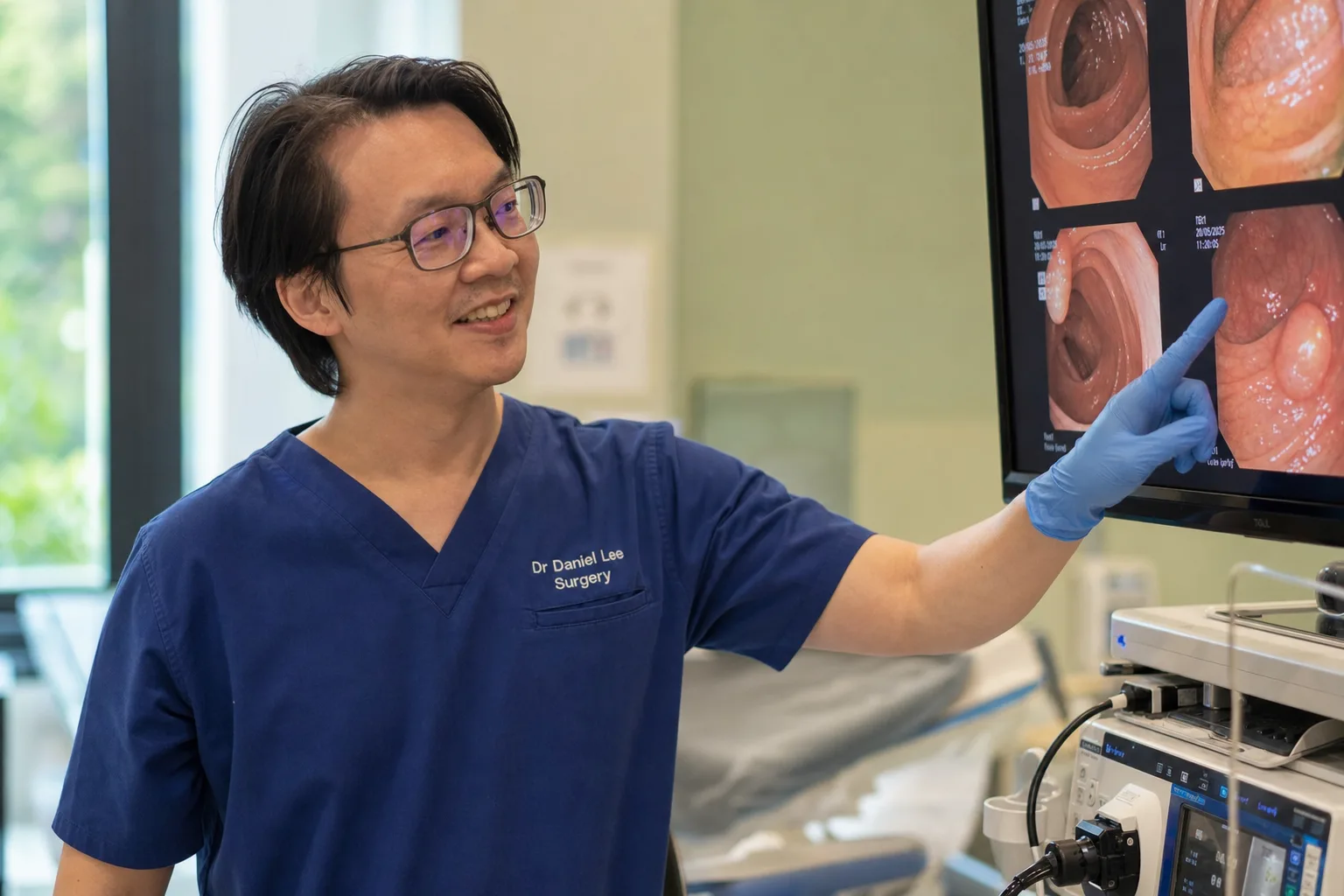
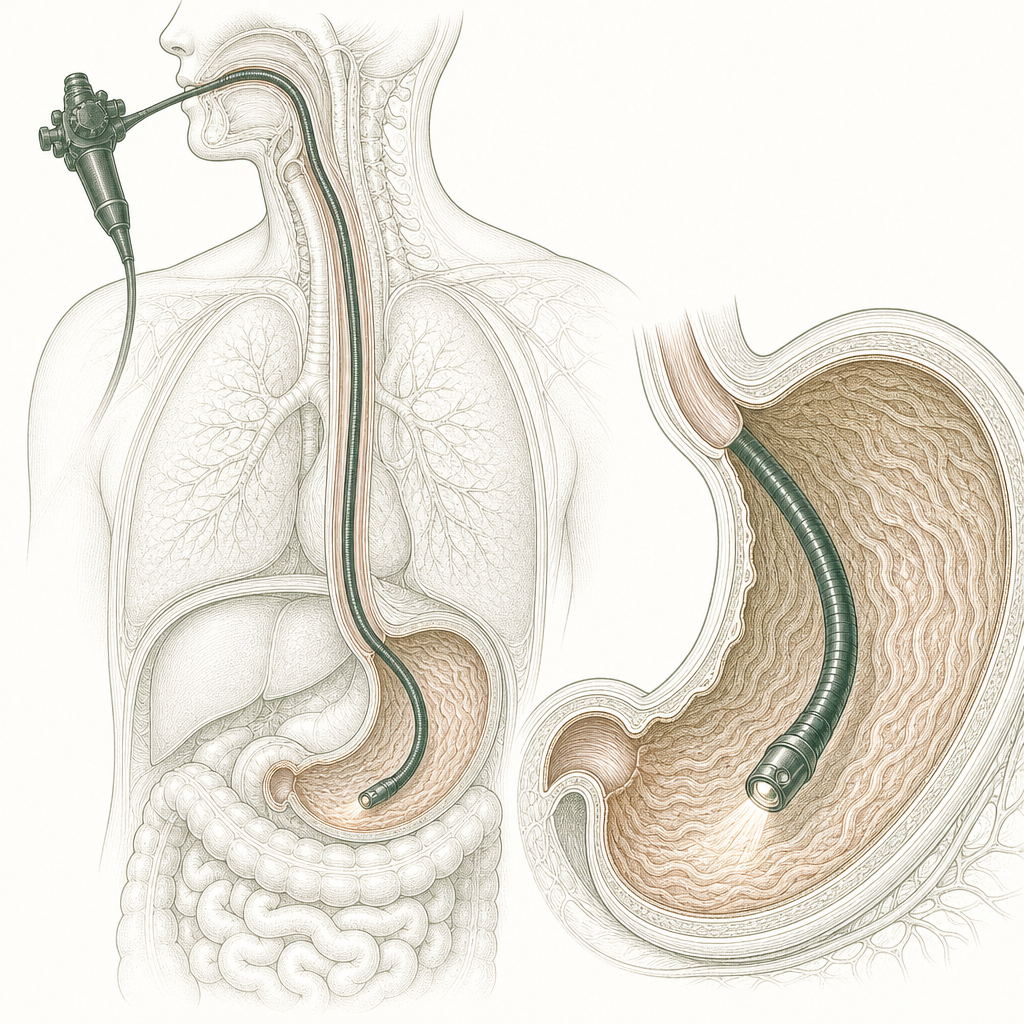
A gentle, guided look at your oesophagus, stomach and the first part of the small bowel.
A gastroscopy, also called an upper GI endoscopy or OGD, uses a thin, flexible camera passed gently through the mouth to examine your oesophagus, stomach and the first part of the small bowel, the duodenum. It lets Dr Lee see the lining directly, which is far more reliable than guessing from symptoms alone. It is both a way to find the cause of a problem and a way to check when something does not add up, such as unexplained low iron.
If something needs a closer look, a small tissue sample, called a biopsy, can be taken during the same gastroscopy, and a test for the Helicobacter pylori bacteria, a common cause of ulcers, can be done at the same time. Most of what a gastroscopy finds is treatable, and finding it early is what makes treatment simpler.
Diagnostic gastroscopy
When you have symptoms such as reflux, indigestion, pain or difficulty swallowing, this finds the cause so the right treatment can follow.
Helicobacter pylori testing
A common cause of stomach ulcers and discomfort. It can be tested for, and a tissue sample taken, during the same gastroscopy.
Investigating low iron or anaemia
When blood tests show low iron without an obvious reason, a gastroscopy helps check the upper digestive tract for a quiet source.
Surveillance gastroscopy
A planned follow-up look for patients with conditions such as Barrett's oesophagus or a previous ulcer, at the interval Dr Lee sets for your situation.
When a gastroscopy is worth doing, and when it should not wait.
Many upper digestive symptoms get dismissed as just gastric and put up with for years. A gastroscopy gives you a clear answer, and most answers are reassuring. The ones that are not are far easier to deal with early, so persistent symptoms are worth checking rather than living around.
- Heartburn, acid reflux or indigestion that keeps coming back
- Pain or difficulty swallowing, or food feeling stuck
- Ongoing upper abdominal pain, bloating or persistent nausea
- Unexplained weight loss, tiredness, or low iron
- A known ulcer, Barrett's oesophagus, or a family history worth checking
Ongoing reflux or trouble swallowing usually has a treatable cause, but it should be checked.
Most upper digestive symptoms come from something benign and treatable, such as acid reflux, gastritis or a Helicobacter pylori infection, not cancer. The point of a gastroscopy is not to confirm your worst fear, it is to find the actual cause and treat it. Difficulty swallowing, food sticking, or unexplained weight loss are the symptoms worth checking sooner rather than later.
Sedated, brief, and home the same day.
Preparing for a gastroscopy is simple. You fast beforehand so the stomach is empty, usually no food for about six hours and clear fluids stopped a couple of hours before. There is no bowel preparation, so it is far less demanding than preparing for a colonoscopy.
The gastroscopy itself usually takes around ten to fifteen minutes and is done under light sedation, so most patients are comfortable and remember little to nothing of it. You rest in the recovery lounge until the sedation wears off, and Dr Lee explains what was found before you leave. Because it is a day procedure, almost everyone goes home the same day.
- Simple fasting preparation, no bowel cleanse needed
- Light sedation, so you are comfortable throughout
- Around ten to fifteen minutes for the procedure itself
- Day procedure, home the same day for almost everyone
A surgeon who built care around older patients.
For an elderly parent, the questions are different. Is the sedation safe? Is the fasting safe alongside their other conditions and medicines? As the former Surgical Lead for Geriatric Surgery at Khoo Teck Puat Hospital, Dr Lee developed assessment and recovery pathways designed around older patients, and co-authored a 2024 review in the Journal of Gastrointestinal Surgery on how surgeon-led geriatric care drives good outcomes in older patients. That same considered approach guides how sedation and recovery are planned for a gastroscopy in older adults.
For families weighing up a gastroscopy or surgery for a parent, that experience is the difference between a procedure and a recovery. More about Dr Lee's background and approach.
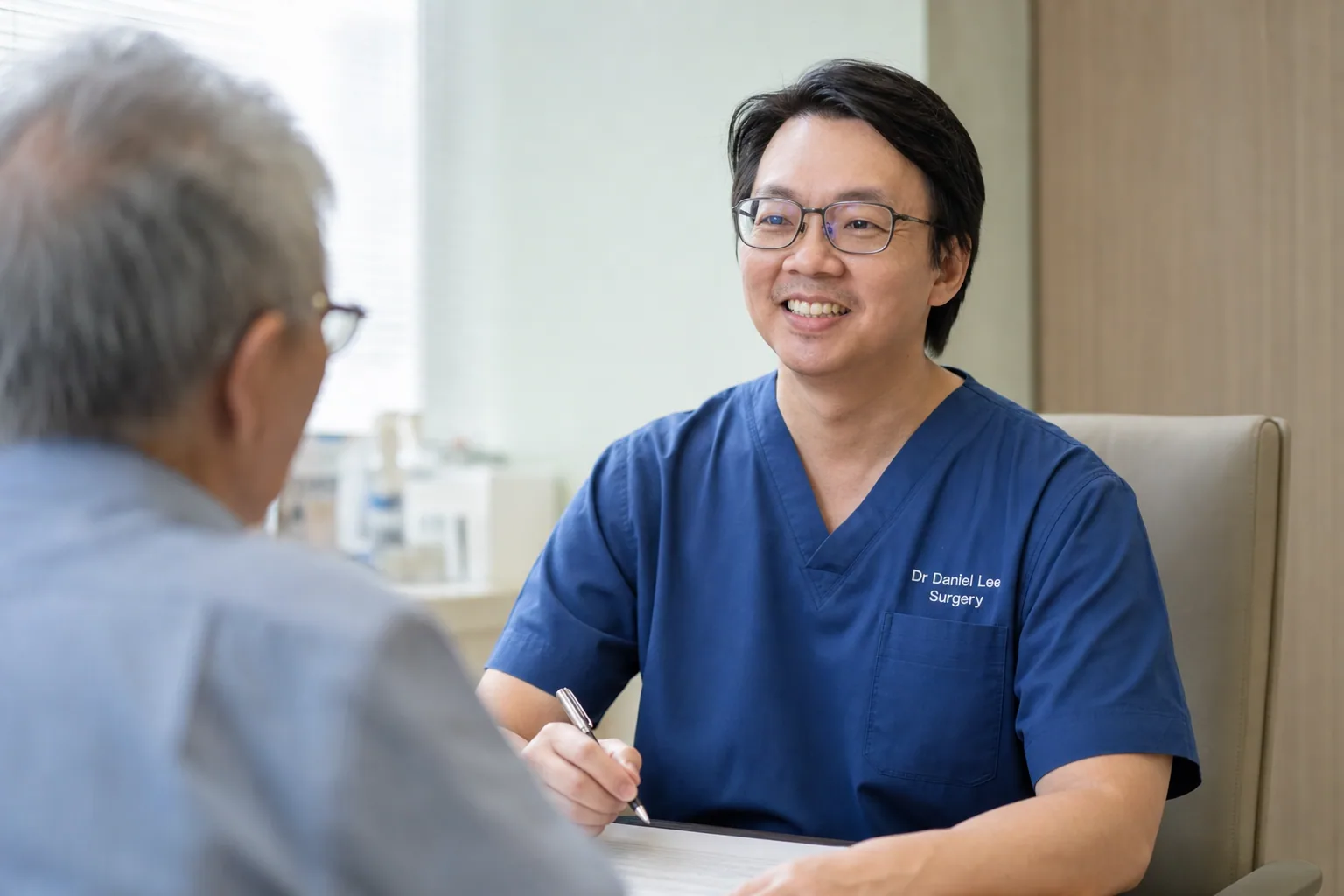
A short recovery, with clear next steps.
Home the same day
Once the sedation has worn off, almost everyone goes home the same day. Because of the sedation, you will need someone to take you home and should not drive that day.
Eating again soon
Once you are fully awake and the throat numbness has settled, you can usually eat and drink normally again. A mildly sore throat for a short while afterwards is normal and settles quickly.
Clear results and a plan
Dr Lee explains what was found before you leave, and any tissue sample or Helicobacter pylori test is sent for analysis. You will know what the results mean and what, if anything, happens next.
Clear gastroscopy costs, with MediSave and insurance guidance.
Fees depend on whether a biopsy or Helicobacter pylori test is needed, whether a colonoscopy is done at the same sitting, and the hospital. As a public guide, the Ministry of Health publishes surgeon-fee benchmarks. The figures below are the MOH surgeon-fee benchmark with GST. The anaesthetist (sedation) fee and the hospital or day-surgery facility fee are charged separately and vary by hospital. Your exact fee is explained clearly at consultation, before anything is scheduled.
| Type of procedure | MOH surgeon fee benchmark (with GST) |
|---|---|
| Gastroscopy (upper GI endoscopy)SF701I | SGD 709 to 1,199 |
| Colonoscopy, if done at the same sittingSF702C / SF703C | SGD 1,308 to 1,962 |
These are published fee benchmarks, before MediSave and insurance. A gastroscopy is typically MediSave claimable, and day-surgery procedures are usually covered under Integrated Shield Plans, so most insured patients pay much less out of pocket. The team works out your likely cost with you before anything is scheduled.
Surgeon fee benchmark only. The anaesthetist (sedation) fee (about SGD 600 to 870 with GST) and the hospital or day-surgery facility fee are charged separately and vary by hospital. A gastroscopy is done as a day procedure.
Use what you are entitled to
A gastroscopy is typically MediSave claimable, subject to the withdrawal limits set for the procedure. We help you apply it correctly.
Often covered by your plan
Day-surgery procedures are usually covered under Integrated Shield Plans. We help you understand what your plan covers before anything is scheduled.
We handle the claim
The team assists with the forms and liaises with your insurer where possible, so you can focus on getting it done.
Fee benchmark figures are the Ministry of Health (Singapore) surgeon-fee benchmarks (procedures SF701I, SF702C, SF703C), with GST, and are a public guide, not a quotation.
The plans we work with.
Dr Daniel Lee practises with Colorectal Clinic Associates (CCA). The clinic works with the insurers below, and the team assists with claims and eligibility checks.






















Gastroscopy in Singapore, answered plainly.
Is a gastroscopy painful?
How should I prepare for a gastroscopy?
Does ongoing reflux or indigestion mean something serious?
Can a gastroscopy and colonoscopy be done together?
Will MediSave or my insurance cover it?
I am arranging this for an elderly parent. Is that different?
Gastroscopy across five private hospitals.
Related conditions Dr Lee treats.
A short message is enough to begin.
Whether the gastroscopy is for you or a family member, send a note with your name, number and what you are noticing. Dr Lee's team will reply on WhatsApp and arrange a time and location that suits you.