Hernia surgery in Singapore, with a smoother, keyhole recovery.
A hernia rarely needs to be rushed, but it does need a clear plan. Dr Daniel Lee repairs hernias using keyhole techniques where they are suitable, so discomfort is reduced and getting back to work, sport and daily life is the goal from day one.
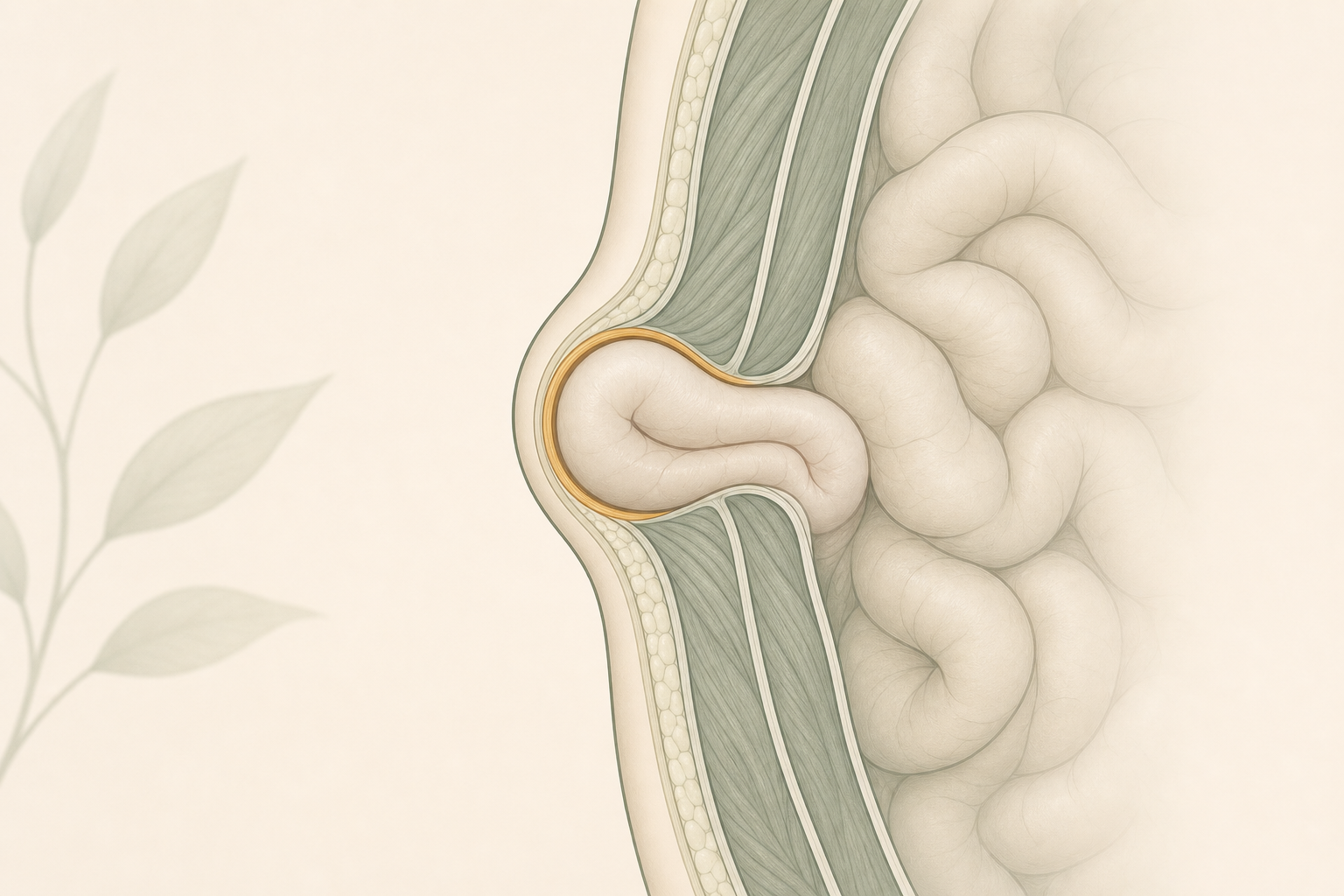
A weak spot in the muscle wall, and a bulge you can often feel.
A hernia happens when soft tissue, often part of the bowel, pushes through a weakened area of the muscle wall. The result is usually a bulge that is easier to see or feel when you stand, cough or strain, and that may settle when you lie down.
It is a common problem, and there is nothing to feel awkward about. What matters is understanding which type you have, and whether it should be repaired now or watched. That is the first question a hernia doctor works through with you at consultation.
Inguinal hernia
The most common type, in the groin. More frequent in men, and often more noticeable when standing, coughing or lifting.
Umbilical hernia
A bulge at or near the navel. Common in adults after pregnancy or with weight gain, and sometimes present from childhood.
Incisional hernia
A bulge through the site of a previous surgical scar, where the healed muscle wall has stayed weak.
Femoral hernia
Lower in the groin or upper thigh, more common in women, and worth assessing promptly because it can be more prone to complications.
When a hernia should be looked at, and when it cannot wait.
Many hernias cause a bulge with some aching or dragging discomfort, which is worth assessing before it grows. A hernia does not repair itself, and it tends to enlarge with time, so an early consultation with a hernia specialist gives you more options and a clearer plan.
- A groin lump, or a bulge in the abdomen or near a previous scar
- Aching, heaviness or discomfort when standing or lifting
- A lump that becomes more obvious through the day
- Discomfort that is starting to limit work or activity
When a hernia is an emergency.
Rarely, a hernia can become trapped and lose its blood supply, which is called strangulation. If a hernia becomes suddenly very painful, firm and tender, will not push back in, or comes with nausea, vomiting or skin that looks red or discoloured, treat it as an emergency and go to the nearest hospital accident and emergency department straight away.
Waiting carries a cost of its own. For a groin hernia on one side, the Ministry of Health typical private bill is SGD 13,724 as planned day surgery, and SGD 22,159 when the same hernia is repaired as an emergency with an inpatient stay. MediSave allows SGD 180 more towards the emergency operation, which does not come near the difference.
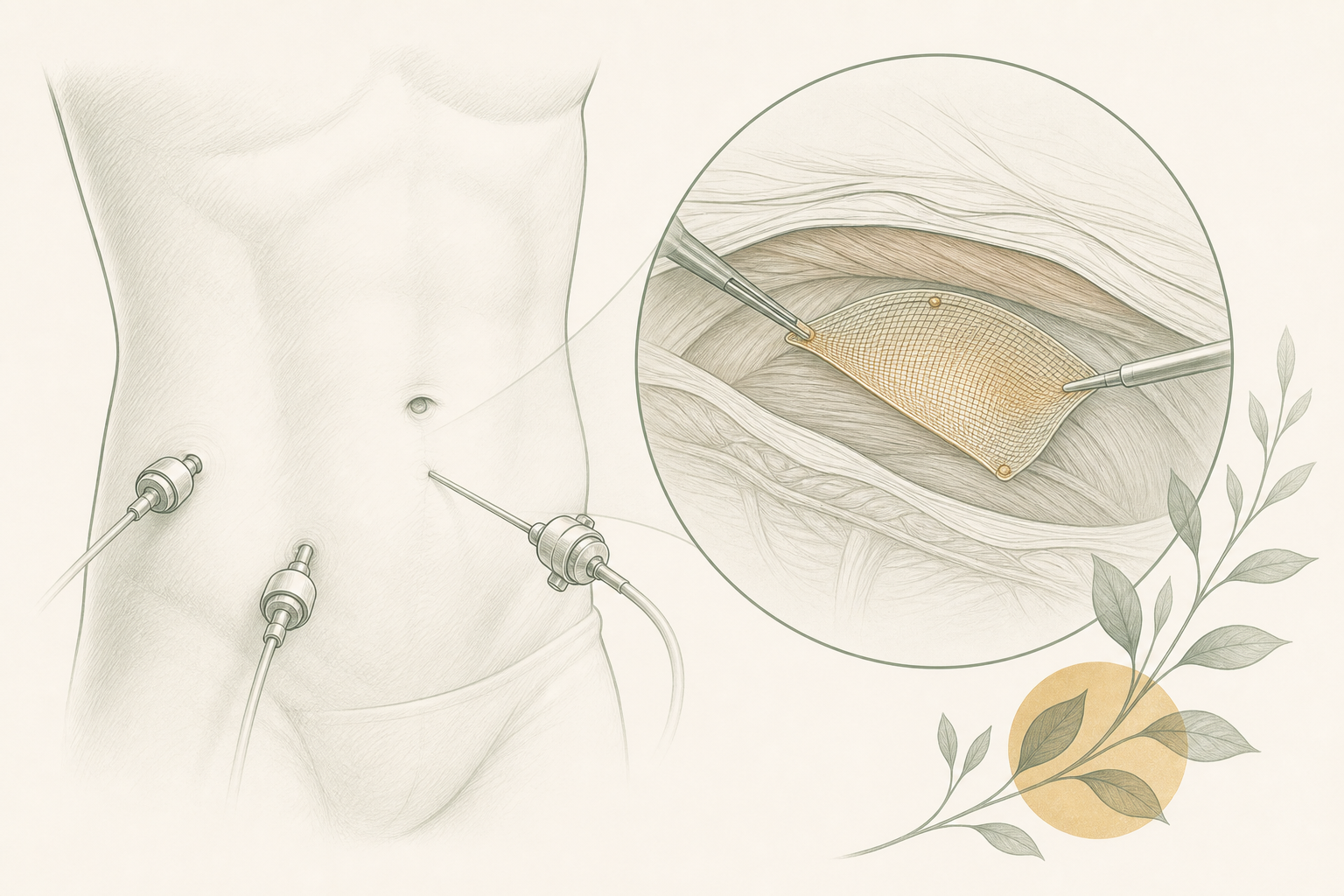
Keyhole hernia surgery, when it is the suitable choice.
In a keyhole, or laparoscopic, repair, a few small cuts are made and a camera guides the surgery. The weakened muscle wall is strengthened, usually with a soft mesh that lowers the chance of the hernia returning.
Keyhole repair is often associated with less discomfort and a quicker return to light activity than open surgery. It is not right for every hernia, so Dr Lee will recommend keyhole or open repair based on your hernia, your health and your history, and explain why before anything is decided.
- Inguinal, umbilical, incisional and femoral hernia repair
- Open or minimally invasive keyhole technique
- Soft mesh reinforcement where appropriate
- Day surgery for suitable cases
The right plan depends on you, not just the hernia.
The plan for someone in their thirties who wants to get back to training is not the same as for an older parent. Dr Lee repairs hernias across that range. As former Surgical Lead for Geriatric Surgery at Khoo Teck Puat Hospital, he built assessment and recovery pathways for older patients and co-authored a 2024 review in the Journal of Gastrointestinal Surgery on surgeon-led care in older patients undergoing colorectal cancer surgery.
For a younger patient that usually means a well-timed keyhole repair and a faster return to sport and lifting. For an older parent it means checking fitness for anaesthesia first, then an honest conversation about repairing now or watching and waiting. A planned repair is almost always gentler than an emergency one. More about Dr Lee's background and approach.

A recovery that is planned, not left to chance.
Home the same day for many patients
Many hernia repairs are carried out as day surgery, so most patients go home the same day with clear aftercare instructions and a number to reach the team.
Back to light activity in one to two weeks
Most desk-based work can resume within about a week, and most people are back to light daily activities within one to two weeks. Heavier lifting, manual work and exercise are resumed gradually, on a timeline Dr Lee sets out for your situation.
Clear guidance at every step
You will know what to expect, what is normal, and when to call. The aim is a recovery with as few surprises as possible.
Clear costs, with MediSave and insurance guidance.
Fees depend on the type of hernia, the technique and the hospital. As a public guide, the Ministry of Health publishes fee benchmarks for both the surgeon and the anaesthetist, per procedure. The figures below are those benchmarks, with GST, and each procedure code links to the MOH page it came from. The hospital or day-surgery facility fee is charged separately and varies by hospital and complexity. Your exact fee is explained clearly at consultation, before anything is scheduled.
| Type of hernia repair | MOH surgeon fee benchmark (with GST) | MOH anaesthetist fee benchmark (with GST) | MediSave withdrawal limit |
|---|---|---|---|
| Groin hernia, one sideinguinal or femoral, SF819A | SGD 3,924 to 6,540 | SGD 1,199 to 1,744 | SGD 1,740 |
| Groin hernia, both sidesinguinal or femoral, SF820A | SGD 6,104 to 9,810 | SGD 1,526 to 2,289 | SGD 2,540 |
| Belly-button or upper-abdomen herniaumbilical or epigastric, SF814A | SGD 3,270 to 5,341 | SGD 1,199 to 1,962 | SGD 1,390 |
| Incisional or recurrent herniaat a previous scar, SF823A | SGD 5,341 to 9,810 | SGD 1,199 to 1,962 | SGD 2,380 |
These are published fee benchmarks, before MediSave and insurance. Hernia repair is typically MediSave claimable and is usually covered by Integrated Shield Plans, so most insured patients pay much less out of pocket. The team works out your likely cost with you before anything is scheduled.
Doctor fee benchmarks only. The hospital or day-surgery facility fee is charged separately, has no MOH doctor-fee benchmark, and varies by hospital and by your ward or day-surgery choice, so it is quoted to you directly. Most hernia repairs are done as day surgery. The MediSave column is the ceiling CPF allows you to withdraw for the operation itself, set by the complexity table each procedure sits in. Ward charges can be claimed on top, up to SGD 830 a day for day surgery, or SGD 1,130 a day for the first two days as an inpatient and SGD 400 a day after that.
What the whole bill usually comes to.
The benchmarks above are the doctors’ share. The figures below are the whole bill, hospital and doctors together, so they answer the question most people are actually asking. Each one is the Ministry of Health typical bill, meaning the middle of what patients were charged across every provider in Singapore, with GST, before any MediSave or insurance payout.
| Type of hernia repair | Public hospital, subsidised, day surgery | Private hospital, day surgery | Private hospital, overnight stay |
|---|---|---|---|
| Groin hernia, one sideSF819A | SGD 1,394 | SGD 13,724 | SGD 16,871 |
| Groin hernia, both sidesSF820A | SGD 2,346 | SGD 26,253 | SGD 26,124 |
| Belly-button or upper-abdomen herniaSF814A | SGD 1,551 | Not published | SGD 17,247 |
| Incisional or recurrent herniaSF823A | SGD 2,048 | Not published | SGD 22,316 |
MOH withholds a figure where fewer than ten patients were treated in that setting, which is why two cells read as not published. That absence is itself useful: a repair at an old scar is less often done as a same-day private procedure.
Use what you are entitled to
Hernia repair is typically MediSave claimable, subject to the withdrawal limits set for the procedure. We help you apply it correctly.
Usually covered by your plan
Hernia surgery is usually covered under Integrated Shield Plans. We help you understand what your plan covers before anything is scheduled.
We handle the claim
The team assists with the forms and liaises with your insurer where possible, so you can focus on getting better.
Fee benchmark figures are the Ministry of Health (Singapore) surgeon and anaesthetist fee benchmarks (procedures SF819A, SF820A, SF814A, SF823A), with GST. Typical bill figures are the MOH published typical bills for the same procedures, covering the whole bill with GST, before insurance. MediSave limits are the CPF Board withdrawal limits for the MOH Table of Surgical Procedures rank each procedure sits in, effective 1 June 2026. All are national figures across Singapore providers, read on 20 August 2026. They are a public guide, not Dr Lee’s fees and not a quotation.
The plans we work with.
Dr Daniel Lee practises with Colorectal Clinic Associates (CCA). The clinic works with the insurers below, and the team assists with claims and eligibility checks.






















Hernia surgery in Singapore, answered plainly.
Do I need surgery, or can a hernia be left alone?
What is the difference between keyhole and open repair?
Is a mesh used, and is it safe?
I am worried about the anaesthesia.
How long is the recovery?
Will MediSave or my insurance cover it?
I am arranging this for an elderly parent. Is that different?
Hernia surgery across five private hospitals.
Related conditions Dr Lee treats.
A short message is enough to begin.
Whether the consultation is for you or a family member, send a note with your name, number and what you are noticing. Dr Lee's team will reply on WhatsApp and arrange a time and location that suits you.