To avoid a large open wound, Dr Lee uses laser through small openings
A fine laser fibre shrinks piles and seals anal fistula and pilonidal tunnels from inside, usually as day surgery. Dr Daniel Lee, FRCS (Edinburgh), was Head of Colorectal Surgery and Surgical Lead, Geriatric Surgery, at Khoo Teck Puat Hospital, and trained at the John Goligher Unit in Leeds. He also performs the conventional operations and will tell you when laser is not the right choice.
Three conditions, each with its own laser technique
Laser proctology is not one operation. The fibre is the same, but where it goes and what it does depend on the problem.
- The pile: a swollen cushion under the lining
- Pinhole entry at the base of the pile
- Heat at the fibre tip shrinks and seals it
- The sensitive line the heat stays above
Laser haemorrhoidoplasty
A pinhole entry at the base of the pile, then heat under the lining shrinks it and seals the vessels feeding it.
- Nothing is cut out, so there is no open wound on the skin
- Usually 30 to 60 minutes, home the same day
- Mainly for grade 2 and 3 internal piles
- Inner opening, closed with a stitch
- The fistula tunnel
- Heat at the fibre tip seals it as it's drawn back
- The sphincter muscle, which is not cut
- Outer opening, widened so it can drain
Laser fistula closure (FiLaC)
The tunnel is cleaned, then a fibre drawn slowly back along it seals it from inside.
- The sphincter muscle is not cut
- A scan and a seton come first, so the tunnel is mapped and settled
- If it doesn't heal, every other option stays open
- Pits in the midline of the buttock crease
- The tunnel under the skin, with trapped hair
- Heat at the fibre tip seals it as it's drawn back
- A side opening, where it can also drain
Laser sinus closure (SiLaC)
The pits are cleaned and the hair cleared, then the tunnel is sealed from inside. A small camera is used first when it branches.
- No large open wound and no daily packing
- Back at work or sport in about 6 days on average
- Can be repeated if it comes back
One idea behind all three: heat from inside, healthy tissue kept
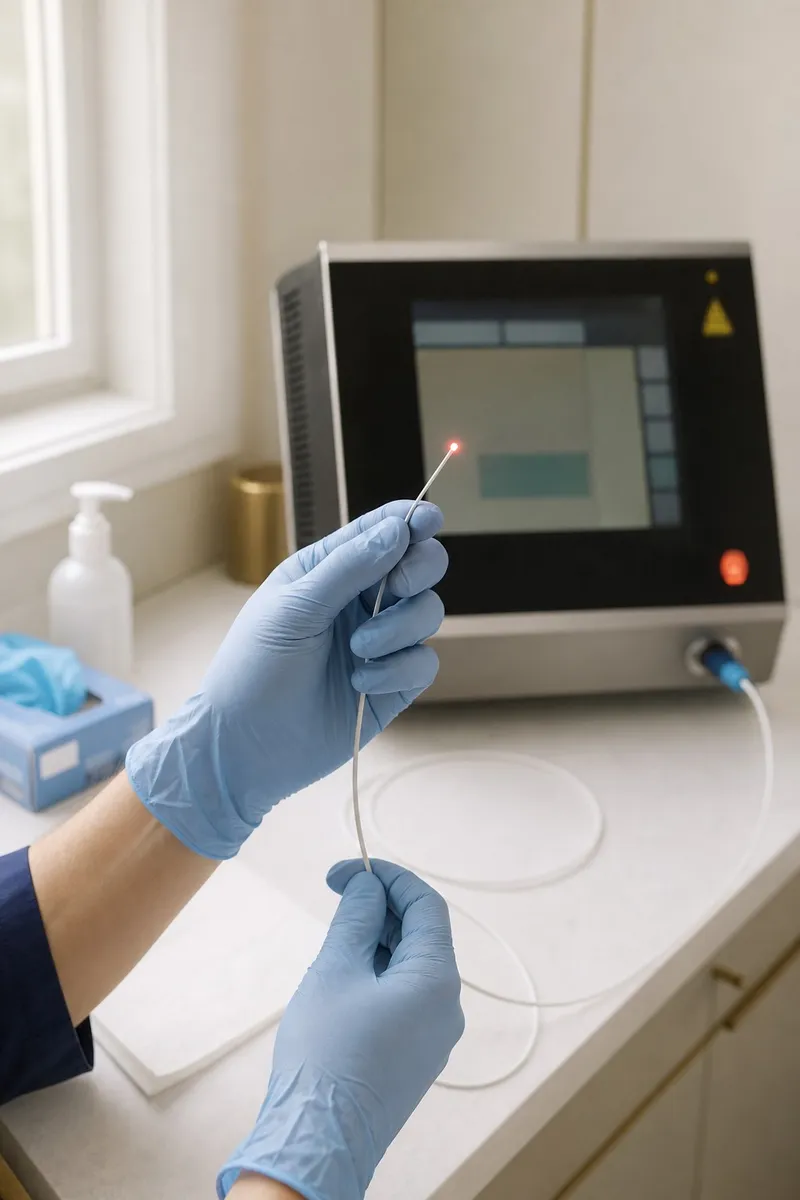
Dr Lee uses a 1470 nm diode laser with a thin radial fibre. Its tip gives off energy all the way round, and that energy turns into gentle heat inside the tissue. In a pile, the heat shrinks the swollen cushion and seals the vessels feeding it. In a fistula or pilonidal tunnel, it shrinks the walls together as the fibre is drawn back, sealing the tunnel.
Because the work happens from inside, through a pinhole, the fistula's own opening or the sinus pits, there is no large wound to heal. That is why the first weeks tend to be easier than after an operation that cuts tissue out. It is also why laser can usually be repeated, or followed by another operation, if the first treatment doesn't fully work.
Laser is not a shortcut, though. How well it works depends on choosing the right patient and preparing properly, so Dr Lee puts his time into both.
I like to treat my patients using minimally invasive surgery whenever possible. And that means a smaller cut, less pain and faster recovery for them.
Laser suits many patients, but not every case
Dr Lee's rule is to match the treatment to the problem. This is how he decides, across the three conditions.
Laser is a good fit for
- Grade 2 and 3 internal piles, where laser on its own is usually enough
- Piles that have come back after earlier treatment
- Anal fistulas that run through a lot of sphincter muscle, or have come back after surgery
- A first-time pilonidal sinus with a few pits, or a branching one using a camera and laser together
- People who want to avoid a large open wound and weeks of dressings, once the right condition is confirmed
Another option may serve you better
- Very large piles that stay outside all the way round
- Skin tags on their own, because laser shrinks the pile inside and does not remove skin tags
- An active abscess or infection, which is drained first
- Active Crohn's disease, which is treated medically first
- A low, simple fistula through very little muscle, where laying it open heals more often
- Very widespread pilonidal disease with a lot of scarring
How laser compares with conventional surgery, condition by condition
Laser keeps the wound small, but for some conditions it is less likely to heal the first time. Here is how that works out for each one.
| Condition | Laser | Conventional surgery |
|---|---|---|
| Piles | Laser haemorrhoidoplasty: the pile is shrunk from inside, nothing cut out. A 2023 review of 9 studies by surgeons at Singapore General Hospital found less pain in the first week and a quicker return to work. At one year, symptoms came back somewhat more often after laser (28.6% against 20.0%), though 2 trials found no significant difference. | Haemorrhoidectomy: the pile is cut out and the wound heals over weeks |
| Anal fistula | FiLaC: the tunnel is sealed from inside, no muscle cut. A 2025 review of 24 laser studies found it healed about 57% first time, with under 1% new change in bowel control. | Fistulotomy: the tunnel is laid open, cutting the muscle it runs through. It healed 84% in a study of 537 patients. A 2021 review of bowel control found about 13% change in bowel control. |
| Pilonidal sinus | SiLaC: the tunnel is sealed through the pits, no packing. In a 311-patient multicentre study, it healed 2 in 3 with one procedure, and people were back at work or sport in about 6 days. About 1 in 4 came back within about 10 months. | Cut out and left open, or closed with a flap of skin |
Figures come from different studies of different patients, so they can't be compared head to head.

A surgeon who offers both laser and the operations it is compared with
Dr Lee has more than 20 years in surgery. He is a Fellow of the Royal College of Surgeons of Edinburgh, completed his colorectal fellowship at the John Goligher Unit in Leeds, and was formerly Head of Colorectal Surgery at Khoo Teck Puat Hospital.
The steps on these pages are how Dr Lee works: a scan and a seton before laser on a fistula, a camera for a branching pilonidal tunnel, and an honest word when laser isn't the right tool.
Because he also performs banding, conventional piles surgery and the other fistula operations, his advice isn't tied to one technique. If another option suits you better, he will say so and explain why.
What recovery looks like after each laser treatment
Piles: the first bowel movement
You go home with stool softeners so the first one is soft, and it is usually less sore than after conventional surgery. Most people take 3 to 7 days off work, and wait about 6 weeks before the gym.
Anal fistula: some drainage
The widened outer opening drains a little for a few weeks while the tunnel heals behind it. A daily rinse and a pad are usually all you need, and most people are back at desk work within days.
Pilonidal sinus: no packing
The small openings drain a little until they close, on average about 6 weeks in one large study. A daily shower and a fresh dressing are usually enough.
Dr Lee gives you written guidance on eating, washing, painkillers and when to call, and reviews you until things have healed.
Fees for laser proctology, and how MediSave and insurance apply
Your fee is explained clearly at consultation and confirmed in writing before anything is booked. MOH publishes no laser-specific fee benchmark, so each treatment page shows the nearest conventional benchmark as a rough guide.
Checked for your case
Whether MediSave applies, and how much, depends on how the procedure is coded under MOH's Table of Surgical Procedures and its withdrawal limits. The team checks this before you book.
Your plan, confirmed first
Plans differ in what they cover. The team helps you get pre-authorisation where your insurer asks for it.
We handle the forms
The team fills in the claim forms and liaises with your insurer where possible, so you can focus on getting better.
The plans we work with
Dr Daniel Lee practises with Colorectal Clinic Associates (CCA). The clinic works with the insurers below, and the team assists with claims and eligibility checks.






















Laser proctology, answered plainly
What is laser proctology?
Does laser treatment hurt?
Is laser better than conventional surgery?
Can the problem come back after laser?
How long will I need off work?
Will I go home the same day?
Does MediSave or insurance cover laser proctology?
I feel embarrassed. Do I have to be examined?
Laser proctology at five private hospitals
Related conditions and treatments
A short message is enough to begin
Send your name, number and what you're noticing. Dr Lee's team will reply on WhatsApp and find a time and place that suits you.