Laser anal fistula treatment that seals the tunnel without cutting the muscle.
Laser closure heals less often than cutting the tunnel open, and Dr Daniel Lee will tell you that plainly, but it keeps every other option open if it doesn't work first time.
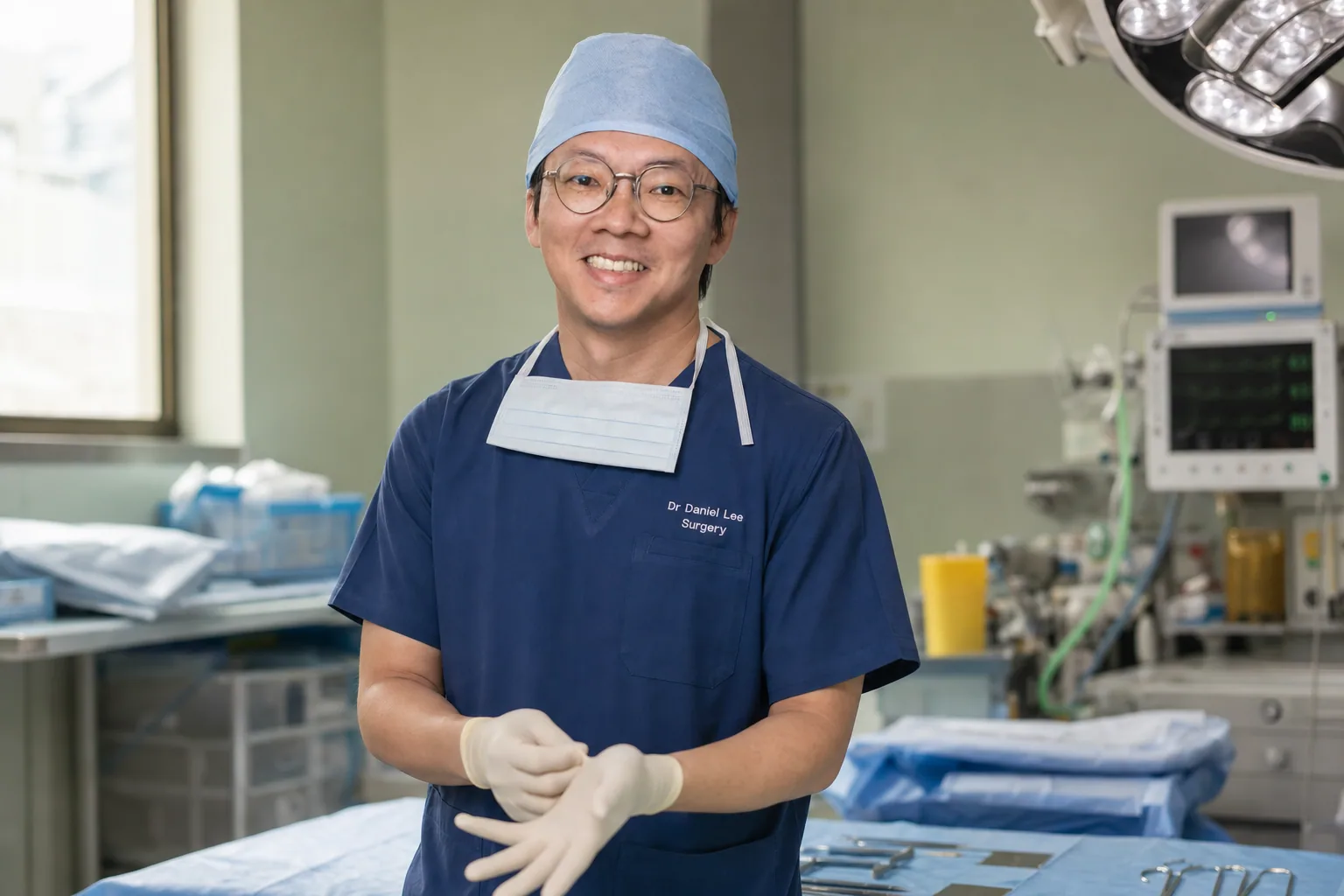
Laser anal fistula treatment in four facts.
The 57% figure is from a 2025 review of 24 studies and 1,503 patients. It is an average across many surgeons and many kinds of fistula, not a prediction for yours.
The tunnel is cleaned, then sealed from inside as the fibre is drawn out.
A fistula usually starts from an infected gland just inside the back passage. The infection tracks through or around the sphincter muscle and opens on the skin, so the tunnel has an inner opening and an outer one. You can read more about the condition on the anal fistula page.
In FiLaC (fistula-tract laser closure), Dr Lee cleans the tunnel, then passes a thin laser fibre in from the outside. Its tip gives off energy all the way round, and as he draws it back slowly the heat shrinks the tunnel's walls together and seals it.
He closes the inner opening with a stitch rather than cutting it out, because cutting widens the hole and the bleeding soaks up laser energy. The outer opening is cored out and widened, so anything left can drain while the tunnel heals behind it. Nothing is divided, so the risk to bowel control from the procedure itself is very low.
- Inner opening, closed with a stitch, not cut out
- The fistula tunnel
- Heat at the fibre tip seals the tunnel as it's drawn back
- The sphincter muscle, which is not cut
- Outer opening, widened so it can drain
Honestly these problems are way more common than you think and we see this all the time. And the truth of the matter is that there's nothing to be embarrassed about.
Signs of an anal fistula that laser closure may help with.
A fistula often follows an abscess near the back passage. If one of these sounds familiar, it's worth a proper look.
- A small opening near the anus that keeps leaking pus or blood
- Soreness or swelling that builds up, then eases when it drains
- An abscess that was drained but keeps coming back
- A fistula that came back after an earlier operation
A painful, swollen, hot lump with fever needs care the same day.
That is usually an abscess, and it needs draining first. Laser closure is never done on an active infection; it comes later, once the area has settled.
Who laser anal fistula treatment suits, and who it doesn't.
The more muscle a fistula runs through, the more a cutting operation risks bowel control, and the more a sphincter-saving option makes sense.
Laser is a good fit for
- Fistulas that run through a lot of sphincter muscle, where cutting it open would risk bowel control
- Fistulas that have come back after earlier surgery
- Women, especially with a fistula at the front, where there's less muscle to spare
- A fistula that has been settled with a seton for at least 2 months
Another option may serve you better
- An active abscess or infection, which is drained first
- Active Crohn's disease, which is treated medically first
- A fistula between the back passage and the vagina
- A low, simple fistula through very little muscle, where laying it open heals more often
From first scan to a healed tunnel, one step at a time.
Laser closure is a staged treatment. Here's the order it happens in.
- First visit
Examination and a plan
Dr Lee examines the area and explains what kind of fistula it's likely to be and what your options are.
- Before surgery
A scan to map the tunnel
An MRI or an ultrasound from inside the back passage shows every branch and any hidden pocket of infection. Missed side branches are one of the main reasons laser closure fails.
- At least 2 months
A seton to settle the tunnel
A soft loose thread is placed through the tunnel so it can drain and firm up. If it is still producing pus at the end of this time, the laser waits.
- Procedure day
Laser closure as a day procedure
Under anaesthetic, the seton comes out, the tunnel is cleaned and sealed with the laser, the inner opening is stitched shut and the outer one is widened. Dr Lee may use a small camera (VAAFT) to check the tunnel first.
- Weeks after
Daily flushing and reviews
You rinse the outer opening each day while it heals, and come back for reviews until the tunnel has closed.
How laser compares with the other anal fistula operations.
Every fistula operation trades healing against bowel control. Operations that cut more muscle tend to heal more often, but put bowel control at more risk.
| Operation | What it does | Healed in studies | Change in bowel control in studies |
|---|---|---|---|
| Fistulotomy | Lays the tunnel open, cutting the muscle it runs through | 84% and 87% in two large studies | About 13% in one review; higher in others |
| LIFT | Ties and divides the tunnel between the two sphincter muscles | About 69% to 79% | About 1.4% to 1.6% |
| Advancement flap | Covers the inner opening with a flap of lining | 66% to 87% | About 13% on average, higher with thicker flaps |
| Laser closure (FiLaC) | Seals the tunnel from inside, no muscle cut | About 57% first time | Under 1% new change |
These figures come from different studies of different patients, so they can't be compared head to head, and studies define a change in bowel control differently; fistulotomy is mostly used for low, simple fistulas. The laser figures come from a 2025 review of 24 studies; the others come from published studies of each operation, including the American colorectal surgeons' 2022 guideline.
What published research says about laser anal fistula treatment.
These are results from other surgeons' published studies, not a promise of your result. Each one links to the paper.
About 57% heal first time
In a 2025 review of 24 studies and 1,503 patients, about 57% of fistulas healed after one laser closure. Of those that healed, about 1 in 5 came back later.
Bowel control problems were rare
New problems with bowel control were rare, about 0.57% in the pooled studies. In a 117-patient series, nobody lost control of solid or liquid stool; 1.7% noticed minor wind or mucus leakage.
If it doesn't heal, options stay open
In that same series, 64% healed first time, and 88% had healed by the end of the study, most of them after a different, conventional operation. About half the fistulas that did not heal became lower, simpler ones that were easier to treat. A repeat laser closure healed about 49% in pooled studies.
Why Dr Lee prepares the way he does
Laser closure tends to fail when a side branch is missed, the tunnel is uneven, or its lining isn't fully cleared. That's why he scans first, settles the tunnel with a seton, stitches the inner opening, and sometimes uses a camera to see inside before sealing it.
Recovery after laser anal fistula treatment, and what is normal.
Some drainage for a few weeks
The widened outer opening is meant to leak a little while the tunnel heals behind it. A pad and a daily rinse are all most people need.
Back to routine quickly
Because there's no large wound and no muscle cut, most people get back to desk work within days. Dr Lee advises on exercise at your review.
How you'll know it is healed
The drainage stops and the outer opening closes over. Dr Lee checks this at review, and sometimes asks for a repeat scan to be sure.

Fees for laser anal fistula treatment, and how MediSave and insurance apply.
Your fee is explained clearly at consultation, before anything is scheduled. Laser closure is usually a day-surgery procedure, with the seton placed at an earlier sitting.
Cost at a glance
Nearest national benchmark: conventional (open) fistula excision, TOSP SF833A
Surgeon’s fee (national benchmark, GST included)
from SGD 2,398
MOH range SGD 2,398 to 3,924is for the conventional (open) surgery, not the laser version; MOH publishes no laser-specific figure, so use it as a rough guide only. Dr Lee’s own laser fee may sit inside or outside this range and is confirmed at consultation.
Anaesthetist’s fee (national benchmark, GST included)
from SGD 763
MOH range SGD 763 to 1,090. The anaesthetist bills separately; the clinic puts the fee in your written estimate.
Hospital and day-surgery fees
quoted when you ask
Billed separately, and shown in your written estimate.
What will you pay in cash?
It depends on your insurer and plan, so the clinic works it out for you.
Leave your name and mobile, then add your insurer and plan name. No IC or policy number needed. You get the estimate in writing, before anything is booked. The estimate is information only, the decision stays yours.
You can check surgeon fees against the published MOH fee benchmark page.
Anaesthetist, imaging and hospital fees are charged separately and vary by hospital.
Paying with MediSave and insurance
Checked for your case
Whether MediSave applies, and how much, depends on how each stage is coded under MOH's Table of Surgical Procedures and its withdrawal limits. The team checks this before you book.
Your plan, confirmed first
Many Integrated Shield Plans cover fistula surgery, but plans differ. The team helps you get pre-authorisation where your insurer asks for it.
We handle the forms
The team fills in the claim forms and liaises with your insurer where possible, so you can focus on getting better.
The plans we work with.
Dr Daniel Lee practises with Colorectal Clinic Associates (CCA). The clinic works with the insurers below, and the team assists with claims and eligibility checks.






















Laser anal fistula treatment, answered plainly.
Will laser treatment affect my bowel control?
Why do I need a seton first, and for how long?
Will the wound keep draining after laser?
How will I know it has healed?
What happens if the laser doesn't work?
Is FiLaC the same as VAAFT?
Is laser anal fistula treatment covered by MediSave or insurance?
Laser anal fistula treatment at five private hospitals.
Related conditions and treatments.
A short message is enough to begin.
Send your name, number and what you're noticing. Dr Lee's team will reply on WhatsApp and find a time and place that suits you.