Understanding your incisional hernia repair
If a hernia coming back worries you, a mesh repair lowers that chance
Dr Daniel Lee, FRCS (Edinburgh), is a former Head of Colorectal Surgery at Khoo Teck Puat Hospital.
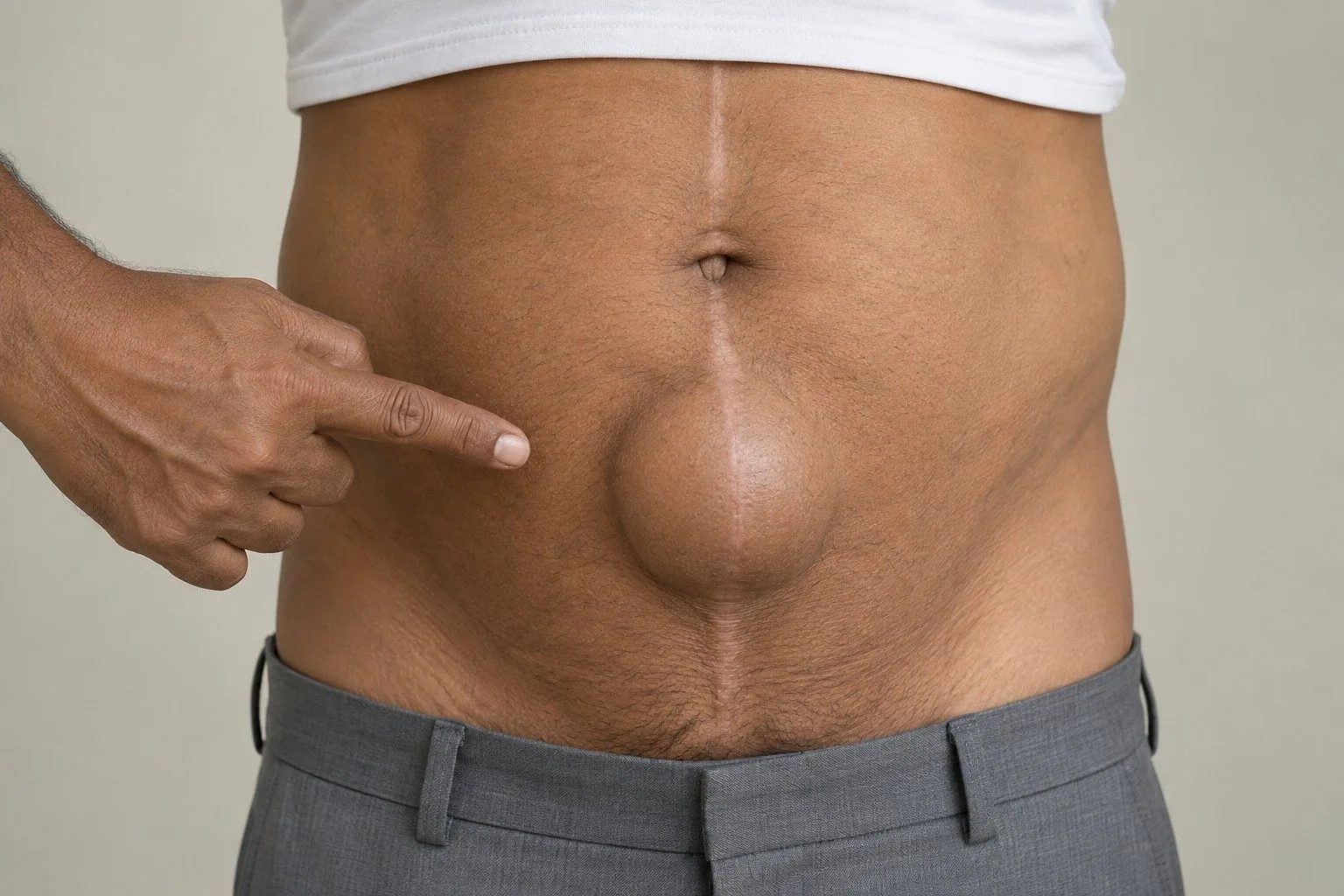
What an incisional hernia is, and how ventral and epigastric hernias relate to it
An incisional hernia is a bulge through the site of a previous surgical scar, where the healed muscle wall has stayed weak. Soft tissue, often part of the bowel, pushes through that weak spot.
It belongs to a wider group called ventral hernias, which are hernias in the front wall of the belly. This page covers three kinds. An umbilical hernia is a bulge at or near the navel. An epigastric hernia is a ventral hernia in the upper abdomen, with its own section below. An incisional hernia is a ventral hernia at the scar of an earlier operation.
The main hernia surgery page covers how each repair works, recovery and insurance.
Signs of an incisional hernia, and the signs that cannot wait
The sign to look for is a bulge at or near the line of an old surgical scar. These signs mean the hernia should be seen soon.
- You can see or feel a bulge at or near an old surgical scar, or elsewhere on the front of the belly.
- You notice aching, heaviness or discomfort at the bulge when standing or lifting.
- The bulge becomes more obvious through the day.
- The discomfort is starting to limit work or activity.
- A bulge that used to push back in no longer does.
Dr Lee notes that many hernias barely hurt, so people often wait for months or even years before having one checked. A hernia does not repair itself, and it tends to get bigger over time.
A scar bulge that turns very painful and firm needs urgent care
Rarely, a hernia can become trapped and lose its blood supply, which is called strangulation. A very painful, firm lump that will not push back in, or one that comes with nausea, vomiting or red or discoloured skin, is a warning sign. If your hernia suddenly becomes very painful and firm or will not push back in, do not wait. Go straight to the nearest A&E or contact us immediately.

Epigastric hernia, a ventral hernia in the upper abdomen that Dr Lee also repairs
An epigastric hernia is one type of ventral hernia, and it is not common. It forms in the upper abdomen, and Dr Lee offers surgery for it, as he does for an incisional hernia.
The 2020 guideline of the European and Americas hernia societies makes mesh its main recommendation, with most of these hernias repaired by an open operation and keyhole repair considered when the gap is large or the wound is at higher risk of problems.
Its authors grade most of its recommendations as weak, because the evidence for these hernias is limited.
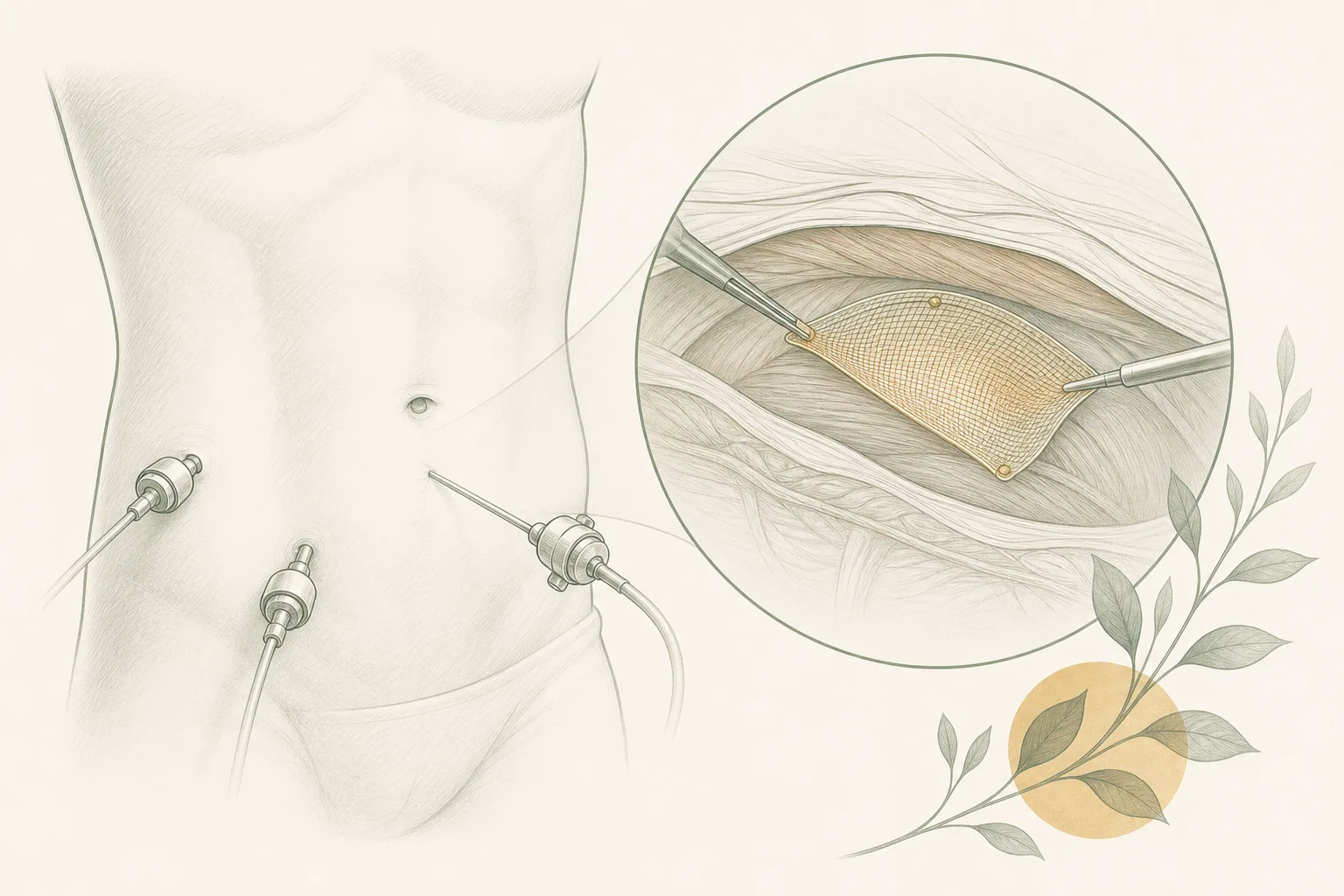
Open, laparoscopic or robotic-assisted repair, and what the studies found on each
In most hernia repairs, Dr Lee first eases the bowel back into place and then places a small piece of surgical mesh to strengthen the weak spot. In the 2023 European Hernia Society guideline, mesh had a lower risk of the hernia coming back than suture repair, and the guideline recommends closing the gap in the muscle wall rather than a mesh that only bridges it.
There are three ways to carry out incisional hernia repair: open, through one long cut over the hernia, and laparoscopic or robotic-assisted, both keyhole methods done through a few small cuts, with a camera guiding the surgery.
A national study from Denmark followed 5,378 patients who had an operation for an incisional hernia between 2007 and 2018.
16.2% against 19.3%
back in hospital within 90 days, after laparoscopic against open repair
7.0% against 12.5%
a further operation for a complication, laparoscopic against open
0.6% against 0.3%
a further operation for bowel obstruction or bowel resection, twice as common after laparoscopic repair
Laparoscopic repair compared with open repair
In the same Danish study, for gaps 2 to 6 cm wide, patients were less likely to need a later repair of a recurrence after laparoscopic repair.
Robotic-assisted repair compared with open and laparoscopic repair
A 2023 review of robotic surgery for ventral hernias as a group, which includes scar hernias, pooled 32 studies: robotic-assisted repair had fewer complications and a shorter hospital stay than open repair, fewer bowel injuries than laparoscopic repair, and took longer than either.
Reading the studies together
These studies ask different questions of different groups of patients, so they do not point to one method that suits everyone.
The European guideline takes the same position: laparoscopic, robotic or open surgery may be appropriate, depending on the patient and the hernia, provided the surgeon has the matching experience.
Dr Lee recommends one way of repairing the hernia based on your hernia, your health and your history, and explains why before anything is decided.
A scar hernia that has already come back is harder to repair, so the plan starts from your history
A matched study from Beijing of hernias that had come back found similar recurrence and complications after laparoscopic and open repair, and linked poor outcomes more to an unfavourable risk profile, such as a larger gap in the muscle wall, than to the technique itself.
Dr Lee plans a repeat repair around your hernia, your health and your history, and explains why before anything is decided.

Getting ready for an operation, and the risk factors that can be changed
Before a planned repair of a scar hernia, the European guideline advises working first on the risk factors that can be changed: weight, blood sugar control measured by HbA1c, smoking and lung fitness, because the risk of complications rises with a higher body mass index.
Losing weight can take a long time, and for a hernia that causes symptoms the guideline says the risks of waiting may come to outweigh the benefit of further weight loss, which needs careful discussion with you.
For planning, it recommends a CT or MRI scan when surgery is being considered.
What the Ministry of Health fee benchmarks show for scar hernia and epigastric hernia surgery
The Ministry of Health publishes fee benchmarks for the surgeon and the anaesthetist. The first below is for a hernia at a previous scar, including one that has come back, the second for an umbilical or epigastric hernia; both include GST.
Hernia assessment with Dr Lee: SGD 150
| Type of repair | MOH surgeon fee benchmark (with GST) | MOH anaesthetist fee benchmark (with GST) |
|---|---|---|
| Incisional or recurrent herniaat a previous scar, SF823A | SGD 5,341 to 9,810 | SGD 1,199 to 1,962 |
| Belly-button or upper-abdomen herniaumbilical or epigastric, SF814A | SGD 3,270 to 5,341 | SGD 1,199 to 1,962 |
These are national benchmarks before MediSave and insurance, not Dr Lee's own fee, and the hospital fee is charged separately.
Many hernia repairs are done as day surgery, whether laparoscopic, robotic-assisted or open
Whether day surgery suits your repair depends on the hernia and on you, and Dr Lee advises on it at the consultation.
These are typical times after a planned repair, and your own recovery depends on the repair, your health and your work.
Simple pain relief
After most hernia repairs, the first few days are usually managed with simple pain relief, and walking and light daily tasks can start straight away.
Desk work and driving
Most people are back at a desk job and driving within one to two weeks.
Usual activities
By around three months most people are back to all their usual activities, including heavy lifting.
Questions about incisional hernia surgery, answered plainly by Dr Daniel Lee
Will an incisional hernia come back after it is repaired?
No repair can promise that a hernia will never come back, but a mesh repair lowers the chance of it coming back.
In the European guideline's pooled data for midline incisional hernias, mesh had a lower risk of recurrence than suture repair. In a 2026 pooled analysis of 15 randomised trials, laparoscopic and open repair had a similar chance of the hernia coming back.
The guideline also names weight, blood sugar control and smoking as the risk factors that can be changed before surgery. Dr Lee goes through what applies to you.
Is surgery for an incisional hernia open, keyhole or robotic-assisted, and what are the drawbacks of each?
Dr Lee recommends one way of repairing the hernia based on your hernia, your health and your history, and explains why. The studies do not point to one method for everyone.
Laparoscopic repair was linked with fewer wound infections in the pooled trials, and with fewer readmissions and fewer further operations for complications in the Danish study. It was also linked with a higher risk of bowel injury in the pooled trials, and with further operations for bowel obstruction or bowel resection twice as common in the Danish study.
Robotic-assisted repair of ventral hernias had fewer complications and a shorter hospital stay than open repair, but the operations took longer than open or laparoscopic repair.
The European guideline says laparoscopic, robotic or open surgery may be appropriate, depending on the patient and the hernia, provided the surgeon has the matching experience.
Is mesh always used, and does it carry risks?
In most hernia repairs, Dr Lee places a small piece of surgical mesh to strengthen the weak spot. A mesh repair lowers the chance of a hernia coming back.
The guideline's pooled data also found more seroma, a fluid collection, after mesh repair than after suture repair. It advises caution with any mesh inside the abdominal cavity, where it touches the bowel, because of the risk of long-term complications at any later abdominal operation.
Dr Lee explains the repair planned for you, including the mesh.
Do I need surgery straight away, or can an incisional hernia wait?
Dr Lee says a hernia operation rarely needs to be rushed. A hernia does not repair itself, however, and the bowel can get trapped in the gap, which can mean an emergency operation.
For a reducible midline incisional hernia, the European guideline puts the risk of strangulation or bowel obstruction at 1 per cent in the first year and 2.5 per cent by five years. For a hernia that causes symptoms in a patient who is fit for surgery, it suggests repair after a detailed discussion of the risks and benefits of surgery and of watchful waiting.
A hernia that suddenly becomes very painful and firm, or will not push back in, needs urgent care.
How is an epigastric hernia different from an incisional hernia?
Both are ventral hernias, which are hernias in the front wall of the belly. An incisional hernia forms at the site of an earlier surgical scar, where the healed muscle wall has stayed weak. An epigastric hernia forms in the upper abdomen, and Dr Lee notes that it is not common.
Dr Lee offers surgery for both. For an epigastric hernia, the 2020 guideline makes mesh its main recommendation, and most are repaired by an open operation with a flat mesh.
How much does surgery for a hernia at a scar cost?
The Ministry of Health benchmark for the surgeon's fee for an incisional or recurrent hernia at a previous scar is SGD 5,341 to 9,810 with GST, and for the anaesthetist SGD 1,199 to 1,962. For an umbilical or epigastric hernia, the surgeon's benchmark is SGD 3,270 to 5,341. These are national benchmarks, not Dr Lee's fees, and the hospital fee is charged separately.
MediSave can be used for eligible hernia surgery within MOH limits, and Integrated Shield plans usually cover it, depending on your policy. The team gives you a written estimate before anything is booked.
When can I walk, drive, go back to work and lift again after the operation?
Walking and light daily tasks can start straight away, and the first few days are usually managed with simple pain relief.
Most people are back at a desk job and driving within one to two weeks. By around three months, most people are back to all their usual activities, including heavy lifting. Pain that is still there at three months should be checked rather than put up with.
These are typical times after a planned repair. Your own recovery depends on the repair, your health and your work, and Dr Lee goes through it with you.
Five private hospitals, one team.
Other types of hernia, and the main hernia surgery page
A short message to the clinic is enough to start the conversation
Send a note with your name, number and what you are noticing, whether the bulge appeared last week or you have lived with it for years. Dr Lee's team will reply on WhatsApp and arrange a time and location that suits you.