Hernia
Why a femoral hernia is easy to miss, more likely to get stuck, and checked sooner
 Reviewed by
Dr Daniel Lee,
MMed Surgery (Singapore), FRCS (Edinburgh), FAMS

You've noticed a lump low in your groin, or in the fold where your thigh meets your body, and you're wondering what it is. If it turns out to be a femoral hernia, two things are worth knowing early. It's easy to mistake for something else, and it's more likely than an inguinal hernia to get stuck.
Here's the short answer. This type of hernia is uncommon, about 2 to 4 in every 100 groin hernia repairs, and it's about four times more common in women than in men. In one large Swedish register, 35.9% of femoral repairs were emergency operations, against 4.9% of inguinal repairs. Studies and guidelines point the same way: a timely, planned repair with a mesh, rather than waiting to see what happens. A planned repair is the usual path, and this page sets out the figures behind it, so you know what to watch for and what to do next.
If you're weighing up the operation itself, you can read how hernia surgery is planned and done.
Key takeaways
- A femoral hernia is a hernia low in the groin, close to the thigh. It is about 2 to 4 in every 100 groin hernia repairs, and about four times more common in women than in men.
- It is more likely than an inguinal hernia to get stuck. In a Swedish register study, 35.9% of femoral repairs were emergency operations, against 4.9% of inguinal repairs.
- It is easy to miss. Examination and ultrasound can both fail to find one, and many people have no warning: in one Swedish study of emergency femoral repairs, only 46.7% of people knew they had a hernia beforehand.
- The international guideline suggests a timely mesh repair, by keyhole where a trained surgeon is available, and says a femoral hernia should be ruled out in every woman with a groin hernia.
- If your hernia suddenly becomes very painful and firm, or will not push back in, do not wait. Go straight to the nearest A&E.
What a femoral hernia is and where the lump sits
A hernia happens when part of the bowel pushes through a weak spot in the muscle wall. A femoral hernia is one that forms low in the groin, close to the thigh. Surgeons count it as a groin hernia, like the more familiar inguinal hernia, but it's a different hernia and a much less common one.
The lump sits low in the groin or in the upper thigh, near the fold where your thigh meets your body. It's worth assessing promptly, because this type of hernia can be more prone to complications.
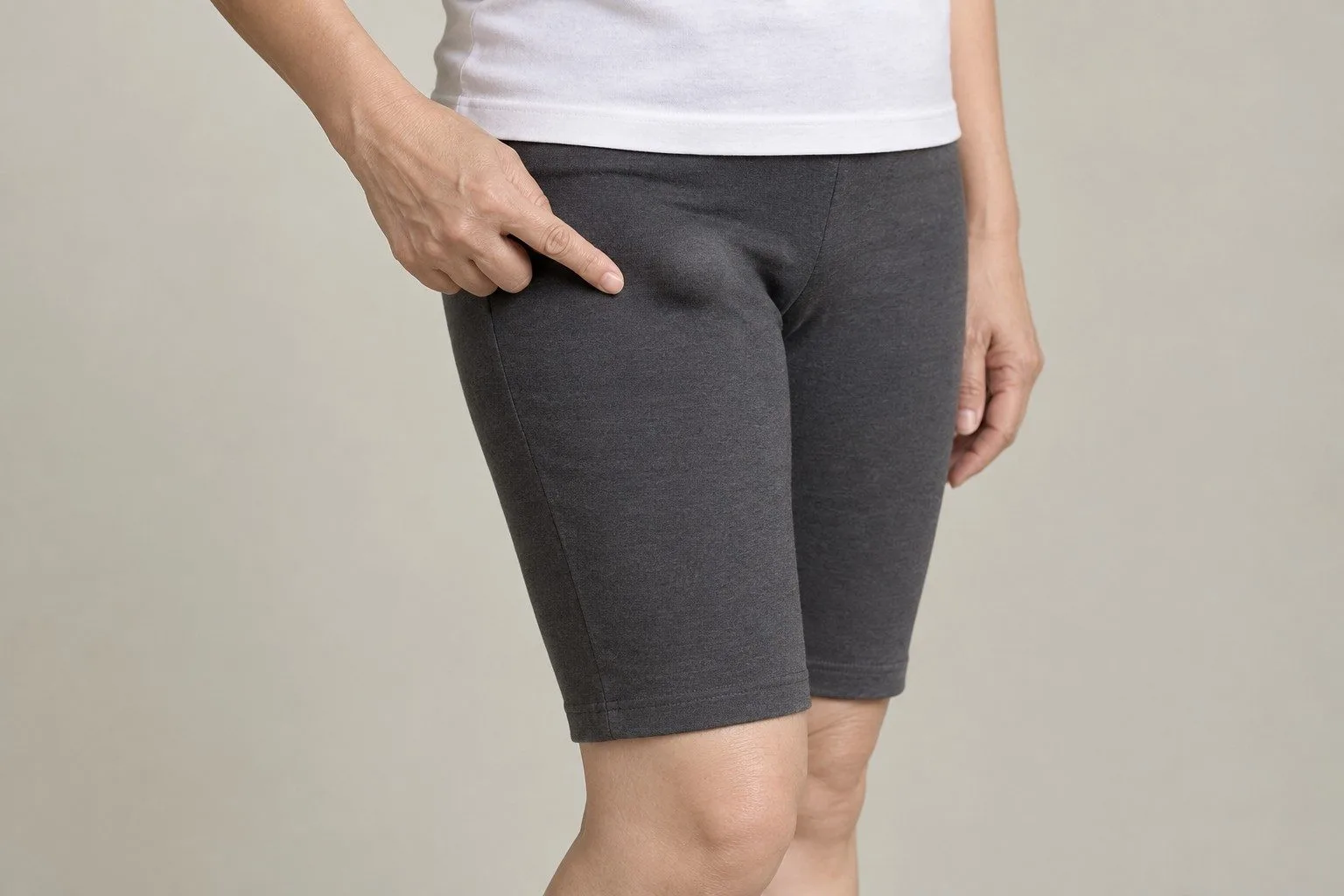
How uncommon is it? The international guidelines for groin hernia management, published by the HerniaSurge Group in 2018, put this type at about 2 to 4 in every 100 groin hernia repairs.
How common this hernia is, and how much more often it affects women
The same guideline says this hernia is about four times more common in women than in men. Inguinal hernias go the other way, and are 9 to 12 times more common in men.
A 2023 review of female groin hernia repairs in the Swedish Hernia Register shows what that looks like in practice. In 2021, femoral repairs made up 28.6% of the groin hernias repaired in women, against about 1% in men. Groin hernias in women are 9% of all groin hernia operations, so women are a small group, but within that group this type is a large share.
| What was measured | Women | Men |
|---|---|---|
| Share of the groin hernias repaired that were femoral, Sweden 2021 | 28.6% | about 1% |
| Femoral repairs that were emergency operations, Sweden 1992 to 2006 | 40.6% | 28.1% |
| How much more common each hernia is | Femoral, about 4 times more common | Inguinal, 9 to 12 times more common |
None of this means a groin lump in a woman is a femoral hernia. It means doctors have good reason to think of one. The guideline says that when a woman has a hernia in the groin, a femoral one should be ruled out in every case.
Why a femoral hernia is more likely to get stuck
Dr Daniel puts the risk plainly for hernias in general: the bowel can get trapped in the gap, and that can mean an emergency operation. This hernia is more likely to get stuck than an inguinal hernia, and the figures show it.
A 2009 Swedish national register study looked at 3,980 femoral repairs. Of those, 35.9% were emergency operations, against 4.9% of 138,309 inguinal repairs. In 22.7% of the emergency femoral repairs, a section of bowel had to be removed, against 5.4% of emergency inguinal repairs.
A 2023 study of people admitted as an emergency with a groin hernia in the north of England, between 2002 and 2016, found the same pattern. Of 6,165 people, 1,467 had a femoral hernia, and 90.1% of them had an operation, against 55.1% of those with an inguinal hernia. A section of bowel was removed in 14.7% of the femoral cases, against 3.5% of the inguinal ones.
| In the studies | Femoral | Inguinal |
|---|---|---|
| Repairs that were emergency operations (Sweden, 1992 to 2006) | 35.9% of 3,980 | 4.9% of 138,309 |
| Emergency repairs where a section of bowel was removed (Sweden) | 22.7% | 5.4% |
| Had an operation after an emergency admission (north of England, 2002 to 2016) | 90.1% of 1,467 | 55.1% |
| Had a section of bowel removed (north of England) | 14.7% | 3.5% |
The guideline lists three risk factors for a hernia getting stuck: being a woman, having a femoral hernia, and having been in hospital before for a groin hernia.
These are averages across many people, not a forecast for you. What they explain is why this hernia is usually checked and treated sooner, rather than watched.
Why this hernia is easy to mistake for an inguinal hernia or a swollen gland
This hernia is hard to pin down. The guideline says that telling it from an inguinal hernia by examination is often difficult, especially in women with more body fat. It adds that ultrasound and examination both depend on who does them, and either one can miss it entirely.
You can see the effect in the figures. In the 2023 Swedish register review, when a hernia first called inguinal came back and needed another operation, a femoral hernia was found in 41.6% of those repeat operations. The guideline suggests that some of these "recurrences" may be hernias that were overlooked the first time.
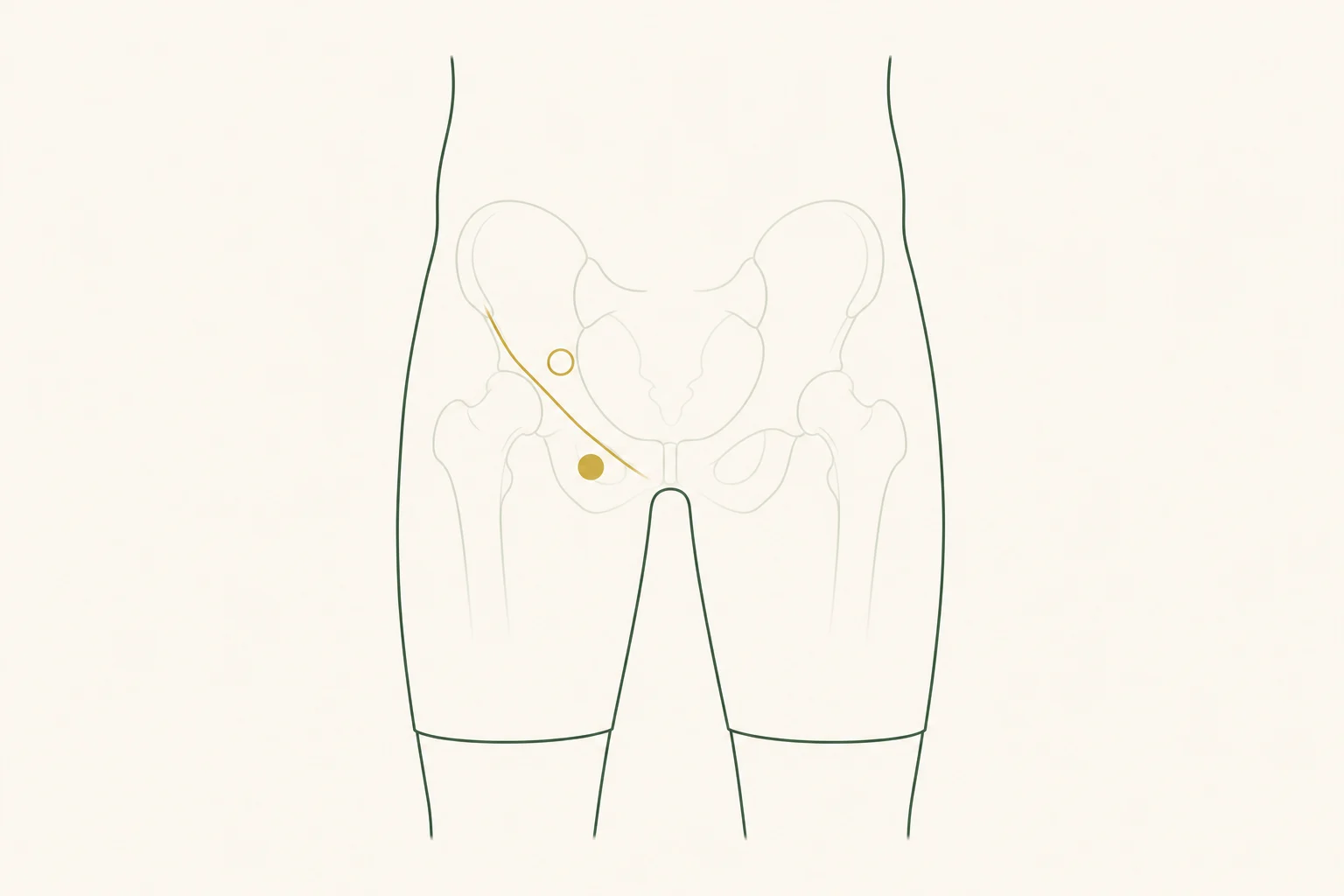
An ultrasound can also show other causes of a groin lump or pain, such as swollen lymph glands, which helps to tell the possibilities apart. If you've been told your lump is a lymph gland, or an inguinal hernia, and it hasn't gone away, it's fair to ask whether a femoral hernia has been ruled out. You can read how an inguinal hernia is repaired on its own page.
What the lump can feel like, and when there is no warning
Many people notice a lump low in the groin, or an ache there. Dr Daniel describes hernias in general as a lump that comes and goes and barely hurts, which is why most people wait for months, even years. What people notice varies:
- a lump low in the groin or in the upper thigh, which may come and go
- an ache or discomfort in the groin
- nothing at all
This hernia can be quieter still. In a Swedish study of 442 people who needed an emergency femoral repair, only 46.7% knew they had a hernia beforehand, and 31.3% said they had no groin symptoms more than 2 weeks before the operation. The 2023 register review reports that study.
So a lump that doesn't hurt may still be worth checking. If you feel one, an examination is more useful than waiting to see whether it becomes painful.
Should a femoral hernia be watched or repaired?
The international guideline is direct about watching a groin hernia in a woman. It says the higher incidence of this hernia in women, and the risk of it getting stuck, argue strongly against a watchful waiting strategy.
The authors of the Swedish register study went further and concluded that this type should be operated on with high priority and repaired with a mesh. In the guideline itself, the strongest agreement of all came on one question: whether a femoral hernia with no symptoms should still be repaired.
High priority doesn't mean a rushed operation. Dr Daniel says hernia surgery in general rarely needs to be rushed. The point of a planned repair is to deal with the hernia before it forces the issue. In that register study, the risk of dying after a planned femoral repair did not exceed that of the general population. After an emergency operation, it was about ten times higher. The two groups were different patients, treated in Sweden between 1992 and 2006, so this is not a forecast for you.
That's the case for planning. A planned repair lets you pick a day, bring your questions and arrange your week, instead of having the hernia pick the day for you.
How a femoral repair works, by keyhole or by open surgery
There are two ways to repair this hernia. In open repair, the surgeon works through one longer cut. In keyhole repair, also called minimally invasive or laparoscopic repair, the surgeon works through a few small cuts instead of one long one. Many hernia repairs are done as day surgery, whether laparoscopic, robotic-assisted or open.
In both, the idea is the one Dr Daniel describes for hernia repair in general: ease the bowel back into place, then use a small piece of surgical mesh to strengthen the weak spot. If you'd like to know more about the mesh, you can read what hernia mesh is made of and where it sits.
| Approach | What it involves | What the sources say |
|---|---|---|
| Open repair | One longer cut, with the mesh placed behind the muscle (the guideline calls this preperitoneal) | The guideline recommends a mesh behind the muscle in an open femoral repair. In planned repairs, the Swedish register study found fewer repeat operations with this than with stitches alone. |
| Keyhole repair | A few small cuts. The surgeon gets a full view of the inguinal and femoral openings, and one mesh can cover both. | The guideline suggests a timely mesh repair, by keyhole where a trained surgeon is available. For women with a groin hernia, it suggests keyhole repair to lower the risk of long-term pain and avoid missing this hernia. In planned repairs, keyhole repair also led to fewer repeat operations than stitches alone. |
| Keyhole repair in an emergency | The same approach, used when the hernia is stuck | Feasible, with results similar to open surgery in the studies so far, though good-quality evidence is lacking. |
For emergencies, a 2023 systematic review of 33 papers found keyhole repair feasible in an emergency femoral operation, with results similar to open surgery in the studies so far, although good-quality evidence is lacking. It can also avoid a larger cut made only to check the bowel.
Which route suits you depends on your hernia and your health, and your surgeon will advise after examining you.
What a planned repair involves, and how soon life gets back to normal
Dr Daniel describes the usual pattern for hernia repairs in general. For most patients it's day surgery, so you go home the same day, and the first few days are usually managed with simple pain relief. Most patients are back to light duty in one or two weeks, and desk work is usually earlier. Those are his words about most hernia repairs, not about femoral repairs in particular, so ask what applies to yours. The recovery section of our hernia surgery page sets out the usual timeline.
It helps to bring a short list to your consultation: which approach is planned and why, whether a mesh will be used and where it will sit, whether you can go home the same day, and which signs mean you should call the clinic or go to A&E.
When to go to A&E, and when to see a doctor sooner
Knowing the signs that should not wait is part of the plan. These two boxes are here so you know when to act, not to alarm you.
Common questions about a femoral hernia, answered plainly
Can a femoral hernia go away on its own?
Dr Daniel's plain way of putting it, for hernias in general, is that a hernia doesn't repair itself. It will slowly get bigger, and the bowel can get trapped in the gap, which can mean an emergency operation. For a groin hernia in a woman, the international guideline argues strongly against simply watching it.
Is a femoral hernia the same as an inguinal hernia?
No. Both are groin hernias, but they are different hernias. The femoral type is about 2 to 4 in every 100 groin hernia repairs and about four times more common in women than in men. An inguinal hernia is 9 to 12 times more common in men. The femoral type is also more likely to get stuck: in the Swedish register, 35.9% of femoral repairs were emergency operations, against 4.9% of inguinal repairs.
Can a man get a femoral hernia?
Yes, but less often. In Sweden in 2021, femoral repairs made up about 1% of the groin hernias repaired in men, against 28.6% in women.
Will an ultrasound find a femoral hernia?
Not always. The guideline says ultrasound and examination both depend on who does them, and either can miss it. An ultrasound can also show other causes of a groin lump or pain, such as swollen lymph glands. It's worth asking how your lump will be checked.
Is a mesh used to repair a femoral hernia?
The authors of the Swedish register study concluded that this hernia should be repaired with a mesh, and the international guideline suggests a timely mesh repair. For planned repairs, the study found fewer repeat operations after keyhole repair, and after open repair with a mesh behind the muscle, than after stitch-only repair.
Can I use MediSave for a femoral hernia repair?
Femoral and inguinal repairs share the same Ministry of Health fee codes for groin hernia surgery, and MediSave may be used for hernia surgery within its limits. What applies to you depends on the operation planned. The fees section of our hernia surgery page is the place to start with fees and MediSave.
The bottom line, and what to do about a groin lump
A femoral hernia is uncommon, easy to miss and more likely than an inguinal hernia to get stuck. It is about four times more common in women, and many people have little or no warning. The studies and the international guideline point to the same plan: a timely, planned repair with a mesh, by keyhole or open surgery, instead of waiting for the hernia to choose the day.
If you've noticed a lump low in your groin, the next step is an examination, not a wait-and-see. To talk through your own hernia with Dr Daniel Lee, you can send the clinic a WhatsApp message.
Written by the clinic's editorial team. This article is general information and not a diagnosis. Your surgeon will advise on your own hernia.